PDF · English
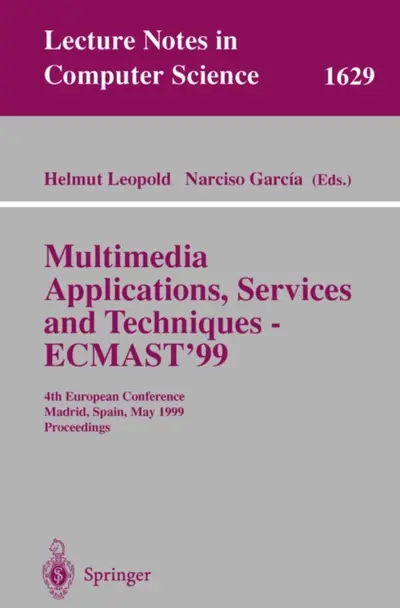
Multimedia Applications, Services and Techniques - ECMAST'99
4th European Conference, Madrid, Spain, May 26-28, 1999, Proceedings
Price and availability
$60.99
Available in: Andorra, Austria, Australia, Belgium, Bulgaria, Canada, Switzerland, Cyprus, Czechia, Germany, Denmark, Estonia, Spain, Finland, France, United Kingdom, Guernsey, Greece, Croatia, Hungary, Ireland, Isle of Man, Iceland, Italy, Jersey, Japan, Liechtenstein, Lithuania, Luxembourg, Latvia, Monaco, Malta, Netherlands, Norway, Poland, Portugal, Romania, Sweden, Slovenia, Slovakia, San Marino, United States, Vatican City, South Africa
Stores: US, UK, Canada, EU, Australia.
Sign in to buyThe price is re-checked by the server before payment.
For personal use under the eBook licence.
- Format
- DRM
- Not stated by the publisher
- Language
- English
- Publisher
- Springer Berlin Heidelberg
- Published
- 26 June 2003
- ISBN
- 9783540487579
- Subjects
- Information theory, Internet guides & online services, Business applications, Graphical & digital media applications, Databases, Computer networking & communications, Information theory, Graphical and digital media applications, Network hardware, Algorithms and data structures, Databases / Data management, Applied computing
About this book
The liberalisation in the telecommunication market and thus the advent of competition has had a tremendous impact on business in this area. New operators have started to offer telecommunication services in competition with the classical national network operators. This in turn will have an impact on the market share, the tariff structure, the Quality of Service (QoS) and the services offered to the end customers. A way to maintain or increase revenue for network operators is to additionally offer new services to the customers. The final target is a so-called "e;Full Service Network (FSN)"e;, which is capable of offering all types of bi-directional multimedia services. The provisioning of new telecommunication services in general and new multimedia services in particular is made possible by the availability of several new technologies as well as through advances in standardisation. R&D policies world-wide but especially in Europe have forced the development of new networking technologies such as ATM, xDSL and HFC as well as new video technologies as defined by DVB and DAVIC.
Bibliographic data © Gardners Books Ltd.