PDF · English
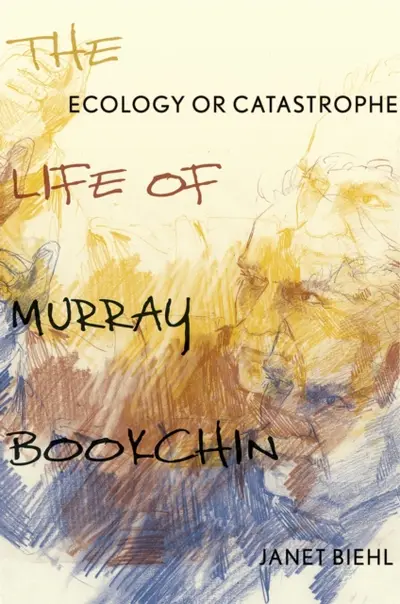
Ecology or Catastrophe
The Life of Murray Bookchin
Price and availability
$33.99
Available in: Andorra, Austria, Australia, Belgium, Bulgaria, Canada, Switzerland, Cyprus, Czechia, Germany, Denmark, Estonia, Spain, Finland, France, United Kingdom, Guernsey, Greece, Croatia, Hungary, Ireland, Isle of Man, Iceland, Italy, Jersey, Japan, Liechtenstein, Lithuania, Luxembourg, Latvia, Monaco, Malta, Netherlands, Norway, Poland, Portugal, Romania, Sweden, Slovenia, Slovakia, San Marino, United States, Vatican City, South Africa
Stores: US, UK, Canada, EU, Australia.
Sign in to buyThe price is re-checked by the server before payment.
For personal use under the eBook licence.
- Format
- DRM
- Not stated by the publisher
- Language
- English
- Publisher
- Oxford University Press
- Published
- 1 September 2015
- ISBN
- 9780199342495
- Subjects
- History of science, Ecological science, the Biosphere, Environmentalist thought & ideology, Social impact of environmental issues, History of science, Ecological science, the Biosphere, Environmentalist thought and ideology, Social impact of environmental issues
About this book
Murray Bookchin was not only one of the most significant and influential environmental philosophers of the twentieth century--he was also one of the most prescient. From industrial agriculture to nuclear radiation, Bookchin has been at the forefront of every major ecological issue since the very beginning, often proposing a solution before most people even recognized there was a problem. Ecology or Catastrophe: The Life of Murray Bookchin is the first biography of this groundbreaking environmental and political thinker. Author Janet Biehl worked as his collaborator and copyeditor for 19 years, editing his every word. Thanks to her extensive personal history with Bookchin as well as her access to his papers and archival research, Ecology or Catastrophe offers unique insight into his personal and professional life. Founder of the social ecology movement, Bookchin first started raising environmental issues in 1952. He foresaw global warming in the 1960s and even then argued that we should look into renewable energy sources as an alternative to fossil fuels. Wary of pesticides and other chemicals used in industrial agriculture, he was also an early advocate of small-scale organic farming, which has developed into the present locavore movement and the revival of organic markets. Even Occupy can trace the origins of its leaderless structure and general assemblies to the nonhierarchical organizational form Bookchin developed as a libertarian socialist. Bookchin believed that social and ecological issues were deeply intertwined. Convinced that capitalism pushes businesses to maximize profits and ignore humanist concerns, he argued that eco-crises could be resolved by a new social arrangement. His solution was Communalism, a new form of libertarian socialism that he developed. An optimist and utopian, Bookchin believed in the potentiality for human beings to use reason to solve all social and ecological problems.
Bibliographic data © Gardners Books Ltd.