PDF · English
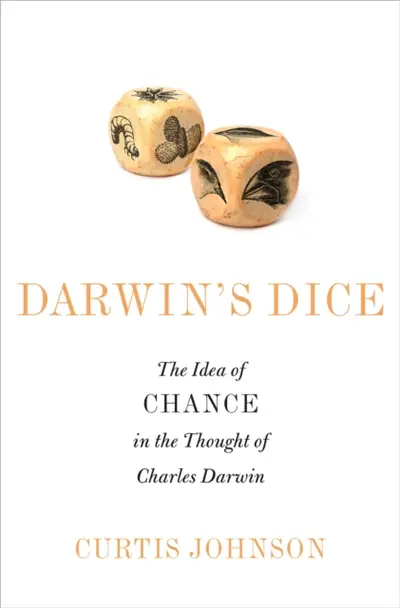
Darwin's Dice
The Idea of Chance in the Thought of Charles Darwin
Price and availability
$29.99
Available in: Andorra, Austria, Australia, Belgium, Bulgaria, Canada, Switzerland, Cyprus, Czechia, Germany, Denmark, Estonia, Spain, Finland, France, United Kingdom, Guernsey, Greece, Croatia, Hungary, Ireland, Isle of Man, Iceland, Italy, Jersey, Japan, Liechtenstein, Lithuania, Luxembourg, Latvia, Monaco, Malta, Netherlands, Norway, Poland, Portugal, Romania, Sweden, Slovenia, Slovakia, San Marino, United States, Vatican City, South Africa
Stores: US, UK, Canada, EU, Australia.
Sign in to buyThe price is re-checked by the server before payment.
For personal use under the eBook licence.
- Format
- DRM
- Not stated by the publisher
- Language
- English
- Publisher
- Oxford University Press
- Published
- 1 September 2014
- ISBN
- 9780199361427
- Subjects
- Philosophy of science, Evolution, Philosophy of science, Evolution / Evolutionary biology
About this book
For evolutionary biologists, the concept of chance has always played a significant role in the formation of evolutionary theory. As far back as Greek antiquity, chance and "e;luck"e; were key factors in understanding the natural world. Chance is not just an important concept; it is an entire way of thinking about nature. And as Curtis Johnson shows, it is also one of the key ideas that separates Charles Darwin from other systematic biologists of his time. Studying the concept of chance in Darwin's writing reveals core ideas in his theory of evolution, as well as his reflections on design, purpose, and randomness in nature's progression over the course of history. In Darwin's Dice: The Idea of Chance in the Thought of Charles Darwin, Curtis Johnson examines Darwin's early notebooks, his collected correspondence (now in 19 volumes), and most of his published writing to trace the evolution of his ideas about chance in evolution. This proved to be one of Darwin's most controversial ideas among his reading public, so much so that it drew hostile reactions even from Darwin's scientific friends, not to mention the more general reader. The firestorm of criticism forced Darwin to forge a retreat, not in terms of removing chance from his theory--his commitment to it was unshakable--but in terms of how he chose to present his theory. Briefly, by changing his wording and by introducing metaphors and images (the stone-house metaphor, the evolution of giraffes, and others), Darwin succeeded in making his ideas seem less threatening than before without actually changing his views. Randomness remained a focal point for Darwin throughout his life. Through the lens of randomness, Johnson reveals implications of Darwin's views for religion, free will, and moral theory. Darwin's Dice presents a new way to look at Darwinist thought and the writings of Charles Darwin.
Bibliographic data © Gardners Books Ltd.