PDF · English
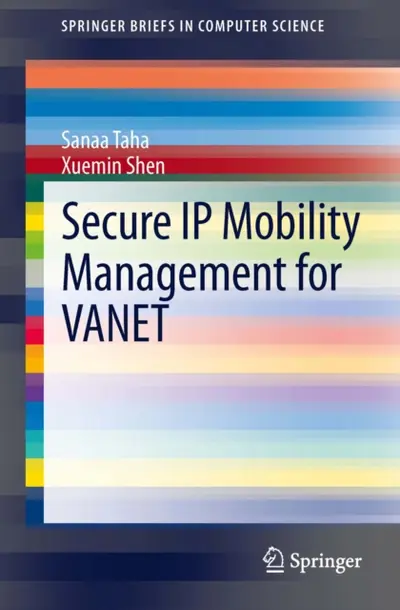
Secure IP Mobility Management for VANET
Price and availability
$60.99
Available in: Andorra, Austria, Australia, Belgium, Bulgaria, Canada, Switzerland, Cyprus, Czechia, Germany, Denmark, Estonia, Spain, Finland, France, United Kingdom, Guernsey, Greece, Croatia, Hungary, Ireland, Isle of Man, Iceland, Italy, Jersey, Japan, Liechtenstein, Lithuania, Luxembourg, Latvia, Monaco, Malta, Netherlands, Norway, Poland, Portugal, Romania, Sweden, Slovenia, Slovakia, San Marino, United States, Vatican City, South Africa
Stores: US, UK, Canada, EU, Australia.
Sign in to buyThe price is re-checked by the server before payment.
For personal use under the eBook licence.
- Format
- DRM
- Not stated by the publisher
- Language
- English
- Publisher
- Springer International Publishing
- Published
- 28 August 2013
- ISBN
- 9783319013510
- Subjects
- Communications engineering / telecommunications, Information technology: general issues, Business applications, Network hardware, Computer security, Computer networking & communications, Network security, Communications engineering / telecommunications, Network hardware, Computer security, Network security, Applied computing
About this book
This brief presents the challenges and solutions for VANETs' security and privacy problems occurring in mobility management protocols including Mobile IPv6 (MIPv6), Proxy MIPv6 (PMIPv6), and Network Mobility (NEMO). The authors give an overview of the concept of the vehicular IP-address configurations as the prerequisite step to achieve mobility management for VANETs, and review the current security and privacy schemes applied in the three mobility management protocols. Throughout the brief, the authors propose new schemes and protocols to increase the security of IP addresses within VANETs including an anonymous and location privacy-preserving scheme for the MIPv6 protocol, a mutual authentication scheme that thwarts authentication attacks, and a fake point-cluster based scheme to prevent attackers from localizing users inside NEMO-based VANET hotspots. The brief concludes with future research directions. Professionals and researchers will find the analysis and new privacy schemes outlined in this brief a valuable addition to the literature on VANET management.
Bibliographic data © Gardners Books Ltd.