EPUB · English
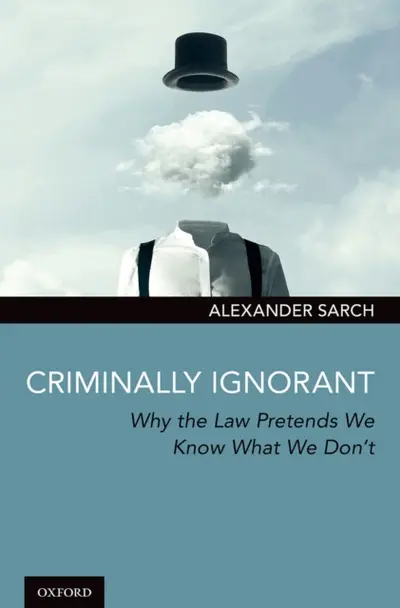
Criminally Ignorant
Why the Law Pretends We Know What We Don't
Price and availability
$87.99
Available in: Andorra, Austria, Australia, Belgium, Bulgaria, Canada, Switzerland, Cyprus, Czechia, Germany, Denmark, Estonia, Spain, Finland, France, United Kingdom, Guernsey, Greece, Croatia, Hungary, Ireland, Isle of Man, Iceland, Italy, Jersey, Japan, Liechtenstein, Lithuania, Luxembourg, Latvia, Monaco, Malta, Netherlands, Norway, Poland, Portugal, Romania, Sweden, Slovenia, Slovakia, San Marino, United States, Vatican City, South Africa
Stores: US, UK, Canada, EU, Australia.
Sign in to buyThe price is re-checked by the server before payment.
For personal use under the eBook licence.
- Format
- EPUB
- DRM
- Not stated by the publisher
- Language
- English
- Publisher
- Oxford University Press
- Published
- 29 May 2019
- ISBN
- 9780190056599
- Subjects
- Ethics & moral philosophy, Jurisprudence & philosophy of law, Criminology: legal aspects, Criminal law & procedure, Methods, theory and philosophy of law, Legal aspects of criminology, Criminal law: procedure and offences, QDTQ
About this book
This is a book about the legal fiction that sometimes we know what we don't. The willful ignorance doctrine says defendants who bury their heads in the sand rather than learn they're doing something criminal are punished as if they knew. Not all legal fictions are unjustified, however. This one, used within proper limits, is a defensible way to promote the aims of the criminal law. Preserving your ignorance can make you as culpable as if you knew what you were doing, and so the interests and values protected by the criminal law can be promoted by treating you as if you had knowledge. This book provides a careful defense of this method of imputing mental states based on equal culpability. On the one hand, the theory developed here shows why the willful ignorance doctrine is only partly justified and requires reform. On the other hand, it demonstrates that the criminal law needs more legal fictions of this kind. Repeated indifference to the truth may substitute for knowledge, and very culpable failures to recognize risks can support treating you as if you took those risks consciously. Moreover, equal culpability imputation should also be applied to corporations, not just individuals. Still, such imputation can be taken too far. We need to determine its limits to avoid injustice. Thus, the book seeks to place equal culpability imputation on a solid normative foundation, while demarcating its proper boundaries. The resulting theory of when and why the criminal law can pretend we know what we don't has far-reaching implications for legal practice and reveals a pressing need for reform.
Bibliographic data © Gardners Books Ltd.