PDF · English
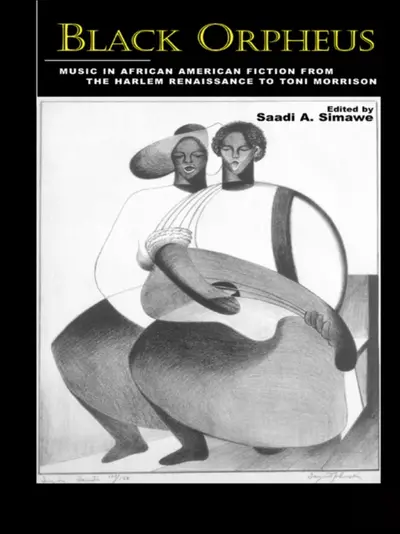
Black Orpheus
Music in African American Fiction from the Harlem Renaissance to Toni Morrison
Price and availability
$85.99
Available in: Andorra, Austria, Australia, Belgium, Bulgaria, Canada, Switzerland, Cyprus, Czechia, Germany, Denmark, Estonia, Spain, Finland, France, United Kingdom, Guernsey, Greece, Croatia, Hungary, Ireland, Isle of Man, Iceland, Italy, Jersey, Japan, Liechtenstein, Lithuania, Luxembourg, Latvia, Monaco, Malta, Netherlands, Norway, Poland, Portugal, Romania, Sweden, Slovenia, Slovakia, San Marino, United States, Vatican City, South Africa
Stores: US, UK, Canada, EU, Australia.
Sign in to buyThe price is re-checked by the server before payment.
For personal use under the eBook licence.
- Format
- DRM
- Not stated by the publisher
- Language
- English
- Publisher
- Taylor & Francis
- Published
- 3 May 2002
- ISBN
- 9781135579838
- Subjects
- Africa, USA, American English, Music, Music: styles & genres, Literary studies: from c 1900 -, Literary studies: fiction, novelists & prose writers, Regional studies, Music, Literary studies: fiction, novelists and prose writers
About this book
The legendary Greek figure Orpheus was said to have possessed magical powers capable of moving all living and inanimate things through the sound of his lyre and voice. Over time, the Orphic theme has come to indicate the power of music to unsettle, subvert, and ultimately bring down oppressive realities in order to liberate the soul and expand human life without limits. The liberating effect of music has been a particularly important theme in twentieth-century African American literature.The nine original essays in Black Orpheus examines the Orphic theme in the fiction of such African American writers as Jean Toomer, Langston Hughes, Claude McKay, James Baldwin, Nathaniel Mackey, Sherley Anne Williams, Ann Petry, Ntozake Shange, Alice Walker, Gayl Jones, and Toni Morrison. The authors discussed in this volume depict music as a mystical, shamanistic, and spiritual power that can miraculously transform the realities of the soul and of the world. Here, the musician uses his or her music as a weapon to shield and protect his or her spirituality. Written by scholars of English, music, women's studies, American studies, cultural theory, and black and Africana studies, the essays in this interdisciplinary collection ultimately explore the thematic, linguistic structural presence of music in twentieth-century African American fiction.
Bibliographic data © Gardners Books Ltd.