PDF · English
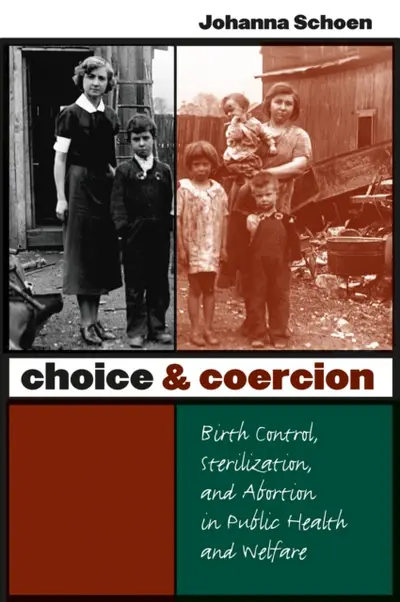
Choice and Coercion
Birth Control, Sterilization, and Abortion in Public Health and Welfare
Price and availability
$27.99
Available in: Andorra, Austria, Australia, Belgium, Bulgaria, Canada, Switzerland, Cyprus, Czechia, Germany, Denmark, Estonia, Spain, Finland, France, United Kingdom, Guernsey, Greece, Croatia, Hungary, Ireland, Isle of Man, Iceland, Italy, Jersey, Japan, Liechtenstein, Lithuania, Luxembourg, Latvia, Monaco, Malta, Netherlands, Norway, Poland, Portugal, Romania, Sweden, Slovenia, Slovakia, San Marino, United States, Vatican City, South Africa
Stores: US, UK, Canada, EU, Australia.
Sign in to buyThe price is re-checked by the server before payment.
For personal use under the eBook licence.
- Format
- DRM
- Not stated by the publisher
- Language
- English
- Publisher
- The University of North Carolina Press
- Published
- 13 March 2006
- ISBN
- 9780807876497
- Subjects
- Ethical issues: abortion & birth control, Gender studies: women, Population & demography, Central government policies, Society and culture: general, Ethical issues, topics and debates: reproductive health, abortion and birth control, Gender studies: women and girls, Central / national / federal government policies
About this book
In August 2003, North Carolina became the first U.S. state to offer restitution to victims of state-ordered sterilizations carried out by its eugenics program between 1929 and 1975. The decision was prompted largely by a series of articles in the Winston-Salem Journal. These stories were inspired in part by the research of Johanna Schoen, who was granted unique access to summaries of 7,500 case histories and the papers of the North Carolina Eugenics Board.In this book, Schoen situates the states reproductive politics in a national and global context. Widening her focus to include birth control, sterilization, and abortion policies across the nation, she demonstrates how each method for limiting unwanted pregnancies had the potential both to expand and to limit womens reproductive choices. Such programs overwhelmingly targeted poor and nonwhite populations, yet they also extended a measure of reproductive control to poor women that was previously out of reach.On an international level, the United States has influenced reproductive health policies by, for example, tying foreign aid to the recipients' compliance with U.S. notions about family planning. The availability of U.S.-funded family planning aid has proved to be a double-edged sword, offering unprecedented opportunities to poor women while subjecting foreign patients to medical experimentation that would be considered unacceptable at home.Drawing on the voices of health and science professionals, civic benefactors, and American women themselves, Schoens study allows deeper understandings of the modern welfare state and the lives of women.
Bibliographic data © Gardners Books Ltd.