EPUB · English
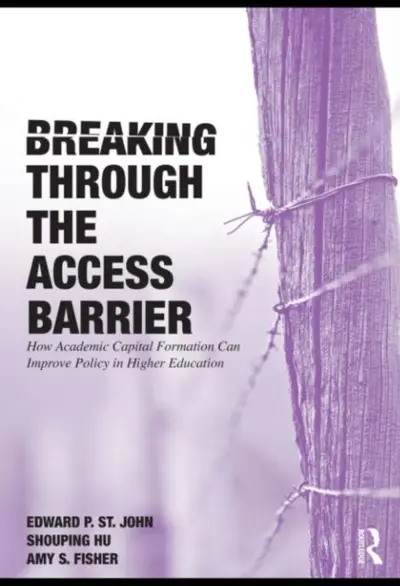
Breaking Through the Access Barrier
How Academic Capital Formation Can Improve Policy in Higher Education
Price and availability
$74.99
Available in: Andorra, Austria, Australia, Belgium, Bulgaria, Canada, Switzerland, Cyprus, Czechia, Germany, Denmark, Estonia, Spain, Finland, France, United Kingdom, Guernsey, Greece, Croatia, Hungary, Ireland, Isle of Man, Iceland, Italy, Jersey, Japan, Liechtenstein, Lithuania, Luxembourg, Latvia, Monaco, Malta, Netherlands, Norway, Poland, Portugal, Romania, Sweden, Slovenia, Slovakia, San Marino, United States, Vatican City, South Africa
Stores: US, UK, Canada, EU, Australia.
Sign in to buyThe price is re-checked by the server before payment.
For personal use under the eBook licence.
- Format
- EPUB
- DRM
- Not stated by the publisher
- Language
- English
- Publisher
- Taylor & Francis
- Published
- 18 October 2010
- ISBN
- 9781136952388
- Subjects
- Social discrimination & inequality, Education, Educational strategies & policy, Higher & further education, tertiary education, Educational strategies and policy, Higher education, tertiary education, Public administration / Public policy
About this book
Breaking Through the Access Barrier argues that the policies designed to address inequalities in college access are failing to address underlying issues of inequality. This book introduces academic capital formation (ACF), a groundbreaking new theory defined by family knowledge of educational options and the opportunities for pursuing them. The authors suggest focusing on intervention programs and public policy to promote improvement in academic preparation, college information, and student aid. This textbook offers: a new construct-academic capital-that integrates and draws upon existing literature on influencing access to college practical advice for better preparation and intervention real student outcomes, databases, and interviews taken from exemplary intervention programs empirical research illuminating the role of class reproduction in education and how interventions (financial, academic, and networking) can reduce student barriers quantitative and qualitative analysis of the importance and effectiveness of several major policy interventions. Written for courses on higher education policy and policy analysis, readers will find Breaking Through the Access Barrier offers valuable advice for working within new policy frameworks and reshaping the future of educational opportunities and access for under-represented students from disadvantaged backgrounds.
Bibliographic data © Gardners Books Ltd.