PDF · English
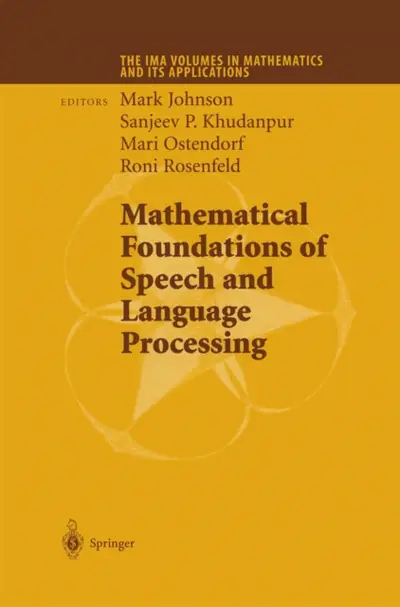
Mathematical Foundations of Speech and Language Processing
Price and availability
$242.99
Available in: Andorra, Austria, Australia, Belgium, Bulgaria, Canada, Switzerland, Cyprus, Czechia, Germany, Denmark, Estonia, Spain, Finland, France, United Kingdom, Guernsey, Greece, Croatia, Hungary, Ireland, Isle of Man, Iceland, Italy, Jersey, Japan, Liechtenstein, Lithuania, Luxembourg, Latvia, Monaco, Malta, Netherlands, Norway, Poland, Portugal, Romania, Sweden, Slovenia, Slovakia, San Marino, United States, Vatican City, South Africa
Stores: US, UK, Canada, EU, Australia.
Sign in to buyThe price is re-checked by the server before payment.
For personal use under the eBook licence.
- Format
- DRM
- Not stated by the publisher
- Language
- English
- Publisher
- Springer New York
- Published
- 6 December 2012
- ISBN
- 9781441990174
- Subjects
- Applied mathematics, Electronics engineering, Mathematical theory of computation, Natural language & machine translation, Pattern recognition, Signal processing, Applied mathematics, Electronics engineering, Mathematical theory of computation, Natural language and machine translation, Pattern recognition, Digital signal processing (DSP)
About this book
Speech and language technologies continue to grow in importance as they are used to create natural and efficient interfaces between people and machines, and to automatically transcribe, extract, analyze, and route information from high-volume streams of spoken and written information.The workshops on Mathematical Foundations of Speech Processing and Natural Language Modeling were held in the Fall of 2000 at the University of Minnesota's NSF-sponsored Institute for Mathematics and Its Applications, as part of a "e;Mathematics in Multimedia"e; year-long program. Each workshop brought together researchers in the respective technologies on the one hand, and mathematicians and statisticians on the other hand, for an intensive week of cross-fertilization. There is a long history of benefit from introducing mathematical techniques and ideas to speech and language technologies. Examples include the source-channel paradigm, hidden Markov models, decision trees, exponential models and formal languages theory. It is likely that new mathematical techniques, or novel applications of existing techniques, will once again prove pivotal for moving the field forward.This volume consists of original contributions presented by participants during the two workshops. Topics include language modeling, prosody, acoustic-phonetic modeling, and statistical methodology.
Bibliographic data © Gardners Books Ltd.