PDF · English
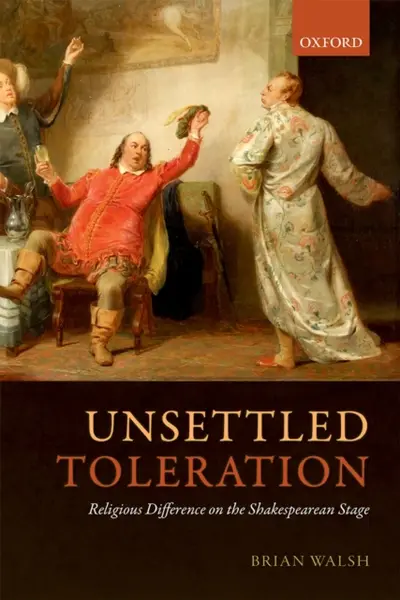
Unsettled Toleration
Religious Difference on the Shakespearean Stage
Price and availability
$95.99
Available in: Andorra, Austria, Australia, Belgium, Bulgaria, Canada, Switzerland, Cyprus, Czechia, Germany, Denmark, Estonia, Spain, Finland, France, United Kingdom, Guernsey, Greece, Croatia, Hungary, Ireland, Isle of Man, Iceland, Italy, Jersey, Japan, Liechtenstein, Lithuania, Luxembourg, Latvia, Monaco, Malta, Netherlands, Norway, Poland, Portugal, Romania, Sweden, Slovenia, Slovakia, San Marino, United States, Vatican City, South Africa
Stores: US, UK, Canada, EU, Australia.
Sign in to buyThe price is re-checked by the server before payment.
For personal use under the eBook licence.
- Format
- DRM
- Not stated by the publisher
- Language
- English
- Publisher
- Oxford University Press
- Published
- 6 May 2016
- ISBN
- 9780191069390
- Subjects
- English, Literary studies: c 1500 to c 1800, Literary studies: plays & playwrights, Shakespeare studies & criticism, Early modern history: c 1450/1500 to c 1700, Religious issues & debates, Christianity, Literary studies: c 1600 to c 1800, Literary studies: plays and playwrights, History
About this book
Unsettled Toleration: Religious Difference on the Shakespearean Stage historicizes and scrutinizes the unstable concept of toleration as it emerges in drama performed on the Elizabethan and Jacobean stages. Brian Walsh examines plays by Shakespeare and his contemporaries that represent intra-Christian conflict between mainstream believers and various minorities, analyzing the sometimes explicit, sometimes indirect, occasionally smooth, but more often halting and equivocal forms of dealing with difference that these plays imagine can result from such exchanges. Through innovative and in some cases unprecedented readings of a diverse collection of plays, from Chapman's An Humorous Day's Mirth, Middleton's The Puritan Widow, Shakespeare's Twelfth Night, Measure for Measure, and Pericles, and Rowley's When You See Me You Know Me, Walsh shows how the English stage in the first decade of the seventeenth century, as a social barometer, registered the basic condition of religious "e;unsettlement "e; of the post-Reformation era; and concurrently that the stage, as a social incubator, brooded over imagined scenarios of confessional conflict that could end variously in irresolution, accommodation, or even religious syncretism. It thus helped to create, sustain and enlarge an open-ended public conversation on the vicissitudes of getting along in a sectarian world. Attending to this conversation is vital to our present understanding of the state of religious toleration the early modern period, for it gives a fuller picture of the ways religious difference was experienced than the limited and inert pronouncements on the topic that officials of the church and state offered.
Bibliographic data © Gardners Books Ltd.