PDF · English
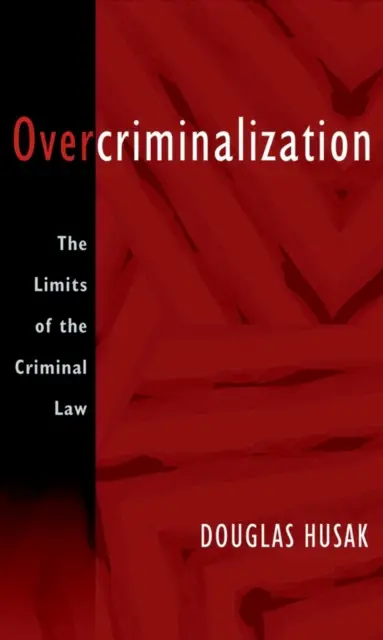
Overcriminalization
The Limits of the Criminal Law
Price and availability
$33.99
Available in: Andorra, Austria, Australia, Belgium, Bulgaria, Canada, Switzerland, Cyprus, Czechia, Germany, Denmark, Estonia, Spain, Finland, France, United Kingdom, Guernsey, Greece, Croatia, Hungary, Ireland, Isle of Man, Iceland, Italy, Jersey, Japan, Liechtenstein, Lithuania, Luxembourg, Latvia, Monaco, Malta, Netherlands, Norway, Poland, Portugal, Romania, Sweden, Slovenia, Slovakia, San Marino, United States, Vatican City, South Africa
Stores: US, UK, Canada, EU, Australia.
Sign in to buyThe price is re-checked by the server before payment.
For personal use under the eBook licence.
- Format
- DRM
- Not stated by the publisher
- Language
- English
- Publisher
- Oxford University Press
- Published
- 8 January 2008
- ISBN
- 9780198043997
- Subjects
- Social & political philosophy, Jurisprudence & philosophy of law, International criminal law, Criminal law & procedure, Methods, theory and philosophy of law, Public international law: criminal law, Criminal law: procedure and offences, QDTS
About this book
The United States today suffers from too much criminal law and too much punishment. Husak describes the phenomena in some detail and explores their relation, and why these trends produce massive injustice. His primary goal is to defend a set of constraints that limit the authority of states to enact and enforce penal offenses. The book urges the weight and relevance of this topic in the real world, and notes that most Anglo-American legal philosophers have neglected it. Husak's secondary goal is to situate this endeavor in criminal theory as traditionally construed. He argues that many of the resources to reduce the size and scope of the criminal law can be derived from within the criminal law itself-even though these resources have not been used explicitly for this purpose. Additional constraints emerge from a political view about the conditions under which important rights such as the right implicated by punishment-may be infringed. When conjoined, these constraints produce what Husak calls a minimalist theory of criminal liability. Husak applies these constraints to a handful of examples-most notably, to the justifiability of drug proscriptions.
Bibliographic data © Gardners Books Ltd.