PDF · English
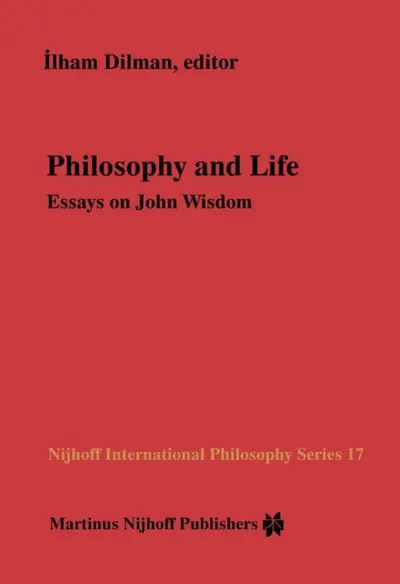
Philosophy and Life
Essays on John Wisdom
Price and availability
$175.99
Available in: Andorra, Austria, Australia, Belgium, Bulgaria, Canada, Switzerland, Cyprus, Czechia, Germany, Denmark, Estonia, Spain, Finland, France, United Kingdom, Guernsey, Greece, Croatia, Hungary, Ireland, Isle of Man, Iceland, Italy, Jersey, Japan, Liechtenstein, Lithuania, Luxembourg, Latvia, Monaco, Malta, Netherlands, Norway, Poland, Portugal, Romania, Sweden, Slovenia, Slovakia, San Marino, United States, Vatican City, South Africa
Stores: US, UK, Canada, EU, Australia.
Sign in to buyThe price is re-checked by the server before payment.
For personal use under the eBook licence.
- Format
- DRM
- Not stated by the publisher
- Language
- English
- Publisher
- Springer Netherlands
- Published
- 6 December 2012
- ISBN
- 9789400961845
- Subjects
- Philosophy, Western philosophy: Ancient, to c 500, Philosophy: metaphysics & ontology, Philosophy, Ancient Greek and Roman philosophy, Philosophy: metaphysics and ontology
About this book
JOHN WISDOM AND THE BREADTH OF PHILOSOPHY hham Dhman 1. THE ESSAYS IN THIS VOLUME The essays following the two pieces by John Wisdom have all been written by philosophers who are former students or friends of Wisdom or who have a high regard for his work. Their contributions were all written with him in mind and to be discussed at a conference honouring his work. This conference was held in August 1983 at Trinity College, Cambridge, of which Wisdom has been a fellow since 1935. Wisdom is a master of discursive reasoning and one of his distinctive contributions in philosophy has been to examine its various forms and their interconnections, particularly the form it takes in philosophical inquiry and the way it advances our understanding there. His concern to bring out the links between all that is abstract in such reasoning and the concrete and particular is well known and represented in many of the essays in this volume. But Wisdom has also a deep appreciation of the kind of understanding that is advanced non-discursively. As he puts it in the first piece in this volume: However skilled a good critic 'I am sure that much of what makes "e;Hamlet"e; "e;Hamlet"e; will run between his fingers'. He has himself advanced our understanding on many questions in philosophy in this way, not simply by what he has said, but also by what he has suggested 'between the lines'.
Bibliographic data © Gardners Books Ltd.