PDF · English
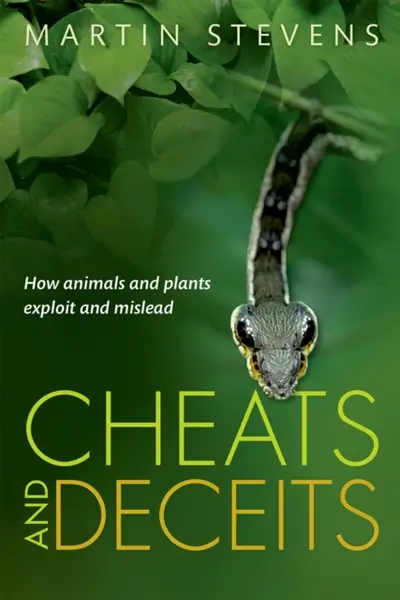
Cheats and Deceits
How Animals and Plants Exploit and Mislead
Price and availability
$24.99
Available in: Andorra, Austria, Australia, Belgium, Bulgaria, Canada, Switzerland, Cyprus, Czechia, Germany, Denmark, Estonia, Spain, Finland, France, United Kingdom, Guernsey, Greece, Croatia, Hungary, Ireland, Isle of Man, Iceland, Italy, Jersey, Japan, Liechtenstein, Lithuania, Luxembourg, Latvia, Monaco, Malta, Netherlands, Norway, Poland, Portugal, Romania, Sweden, Slovenia, Slovakia, San Marino, United States, Vatican City, South Africa
Stores: US, UK, Canada, EU, Australia.
Sign in to buyThe price is re-checked by the server before payment.
For personal use under the eBook licence.
- Format
- DRM
- Not stated by the publisher
- Language
- English
- Publisher
- Oxford University Press
- Published
- 4 February 2016
- ISBN
- 9780191017605
- Subjects
- Popular science, Animal behaviour, Natural history, Wildlife: general interest, Popular science, Ethology and animal behaviour, Nature and the natural world: general interest
About this book
In nature, trickery and deception are widespread. Animals and plants mimic other objects or species in the environment for protection, trick other species into rearing their young, lure prey to their death, and deceive potential mates for reproduction. Cuckoos lay eggs carefully matched to their host's own clutch. Harmless butterflies mimic the wing patterning of a poisonous butterfly to avoid being eaten. The deep-sea angler fish hangs a glowing, fleshy lure in front of its mouth to draw the attention of potential prey, while some male fish alter their appearance to look like females in order to sneak past rivals in mating. Some orchids develop the smell of female insects in order to attract pollinators, while carnivorous plants lure insects to their death with colourful displays. In this book, Martin Stevens describes the remarkable range of such adaptations in nature, and considers how they have evolved, and become increasingly perfected as part of an arms race between predator and prey or host and parasite. He explores the work of naturalists and biologists from Alfred Russel Wallace to current research, showing how scientists find ways of testing the impact of particular behaviours and colourings on the animals it is meant to fool, as opposed to our human perceptions. Drawing on a wide range of examples, Stevens considers what deception tells us about the process of evolution and adaptation.
Bibliographic data © Gardners Books Ltd.