PDF · English
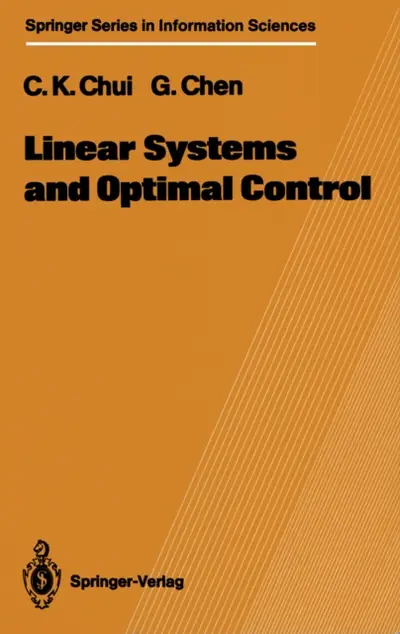
Linear Systems and Optimal Control
Price and availability
$60.99
Available in: Andorra, Austria, Australia, Belgium, Bulgaria, Canada, Switzerland, Cyprus, Czechia, Germany, Denmark, Estonia, Spain, Finland, France, United Kingdom, Guernsey, Greece, Croatia, Hungary, Ireland, Isle of Man, Iceland, Italy, Jersey, Japan, Liechtenstein, Lithuania, Luxembourg, Latvia, Monaco, Malta, Netherlands, Norway, Poland, Portugal, Romania, Sweden, Slovenia, Slovakia, San Marino, United States, Vatican City, South Africa
Stores: US, UK, Canada, EU, Australia.
Sign in to buyThe price is re-checked by the server before payment.
For personal use under the eBook licence.
- Format
- DRM
- Not stated by the publisher
- Language
- English
- Publisher
- Springer Berlin Heidelberg
- Published
- 6 December 2012
- ISBN
- 9783642613128
- Subjects
- Cybernetics & systems theory, Economic theory & philosophy, Business mathematics & systems, Optimization, Geophysics, Maths for engineers, Business applications, Cybernetics and systems theory, Economic theory and philosophy, Business mathematics and systems, Optimization, Geophysics, Maths for engineers, Business applications
About this book
A knowledge of linear systems provides a firm foundation for the study of optimal control theory and many areas of system theory and signal processing. State-space techniques developed since the early sixties have been proved to be very effective. The main objective of this book is to present a brief and somewhat complete investigation on the theory of linear systems, with emphasis on these techniques, in both continuous-time and discrete-time settings, and to demonstrate an application to the study of elementary (linear and nonlinear) optimal control theory. An essential feature of the state-space approach is that both time-varying and time-invariant systems are treated systematically. When time-varying systems are considered, another important subject that depends very much on the state-space formulation is perhaps real-time filtering, prediction, and smoothing via the Kalman filter. This subject is treated in our monograph entitled "e;Kalman Filtering with Real-Time Applications"e; published in this Springer Series in Information Sciences (Volume 17). For time-invariant systems, the recent frequency domain approaches using the techniques of Adamjan, Arov, and Krein (also known as AAK), balanced realization, and oo H theory via Nevanlinna-Pick interpolation seem very promising, and this will be studied in our forthcoming monograph entitled "e;Mathematical Ap- proach to Signal Processing and System Theory"e;. The present elementary treatise on linear system theory should provide enough engineering and mathe- of these two subjects.
Bibliographic data © Gardners Books Ltd.