EPUB · English
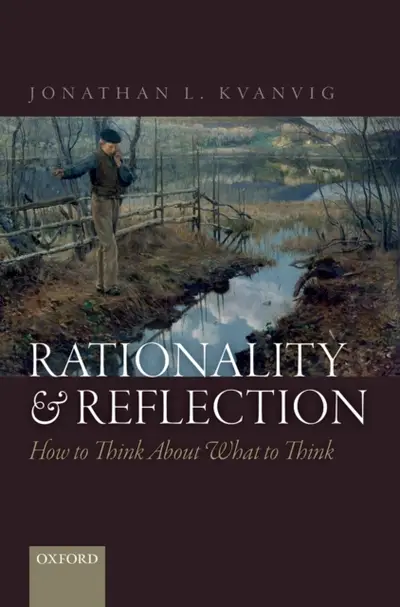
Rationality and Reflection
How to Think About What to Think
Price and availability
$27.99
Available in: Andorra, Austria, Australia, Belgium, Bulgaria, Canada, Switzerland, Cyprus, Czechia, Germany, Denmark, Estonia, Spain, Finland, France, United Kingdom, Guernsey, Greece, Croatia, Hungary, Ireland, Isle of Man, Iceland, Italy, Jersey, Japan, Liechtenstein, Lithuania, Luxembourg, Latvia, Monaco, Malta, Netherlands, Norway, Poland, Portugal, Romania, Sweden, Slovenia, Slovakia, San Marino, United States, Vatican City, South Africa
Stores: US, UK, Canada, EU, Australia.
Sign in to buyThe price is re-checked by the server before payment.
For personal use under the eBook licence.
- Format
- EPUB
- DRM
- Not stated by the publisher
- Language
- English
- Publisher
- Oxford University Press
- Published
- 24 July 2014
- ISBN
- 9780191025754
- Subjects
- Philosophy: epistemology & theory of knowledge, Philosophy of mind, Intelligence & reasoning, Cognition and cognitive psychology, Philosophy: epistemology and theory of knowledge, Philosophy of mind
About this book
Jonathan L. Kvanvig presents a conception of rationality which answers to the need arising out of the egocentric predicament concerning what to do and what to believe. He does so in a way that avoids, on the one hand, reducing rationality to the level of beasts, and on the other hand, elevating it so that only the most reflective among us are capable of rational beliefs. Rationality and Reflection sets out a theory of rationality--a theory about how to determine what to think--which defends a significant degree of optionality in the story of what is reasonable for people to think, and thereby provides a framework for explaining what kinds of rational disagreement are possible. The theory is labelled Perspectivalism and it offers a unique account of rationality, one that cuts across the usual distinctions between Foundationalism and Coherentism and between Internalism and Externalism. It also differs significantly from Evidentialism, maintaining that, to the extent that rationality is connected to the notion of evidence, it is a function both of the evidence one has and what one makes of it.
Bibliographic data © Gardners Books Ltd.