PDF · English
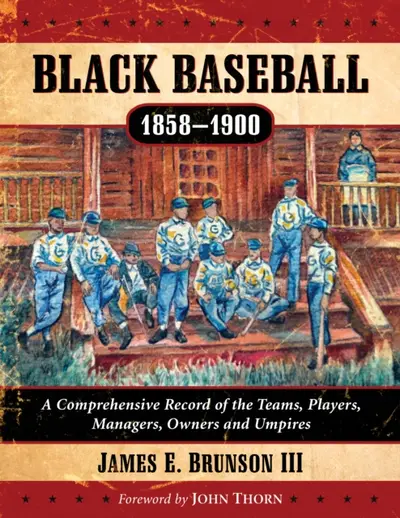
Black Baseball, 1858-1900
A Comprehensive Record of the Teams, Players, Managers, Owners and Umpires
Price and availability
$81.99
Available in: Andorra, Austria, Australia, Belgium, Bulgaria, Canada, Switzerland, Cyprus, Czechia, Germany, Denmark, Estonia, Spain, Finland, France, United Kingdom, Guernsey, Greece, Croatia, Hungary, Ireland, Isle of Man, Iceland, Italy, Jersey, Japan, Liechtenstein, Lithuania, Luxembourg, Latvia, Monaco, Malta, Netherlands, Norway, Poland, Portugal, Romania, Sweden, Slovenia, Slovakia, San Marino, United States, Vatican City, South Africa
Stores: US, UK, Canada, EU, Australia.
Sign in to buyThe price is re-checked by the server before payment.
For personal use under the eBook licence.
- Format
- DRM
- Not stated by the publisher
- Language
- English
- Publisher
- McFarland & Company, Inc., Publishers
- Published
- 22 March 2019
- Pages
- 1394
- ISBN
- 9781476616582
- Subjects
- USA, c 1800 to c 1900, History of sport, Baseball, Encyclopaedias and reference works, Ethnic studies / Ethnicity, Baseball
About this book
This is one of the most important baseball books to be published in a long time, taking a comprehensive look at black participation in the national pastime from 1858 through 1900. It provides team rosters and team histories, player biographies, a list of umpires and games they officiated and information on team managers and team secretaries. Well known organizations like the Washington's Mutuals, Philadelphia Pythians, Chicago Uniques, St. Louis Black Stockings, Cuban Giants and Chicago Unions are documented, as well as lesser known teams like the Wilmington Mutuals, Newton Black Stockings, San Francisco Enterprise, Dallas Black Stockings, Galveston Flyaways, Louisville Brotherhoods and Helena Pastimes. Player biographies trace their connections between teams across the country. Essays frame the biographies, discussing the social and cultural events that shaped black baseball. Waiters and barbers formed the earliest organized clubs and developed local, regional and national circuits. Some players belonged to both white and colored clubs, and some umpires officiated colored, white and interracial matches. High schools nurtured young players and transformed them into powerhouse teams, like Cincinnati's Vigilant Base Ball Club. A special essay covers visual representations of black baseball and the artists who created them, including colored artists of color who were also baseballists.
Bibliographic data © Gardners Books Ltd.