EPUB · English
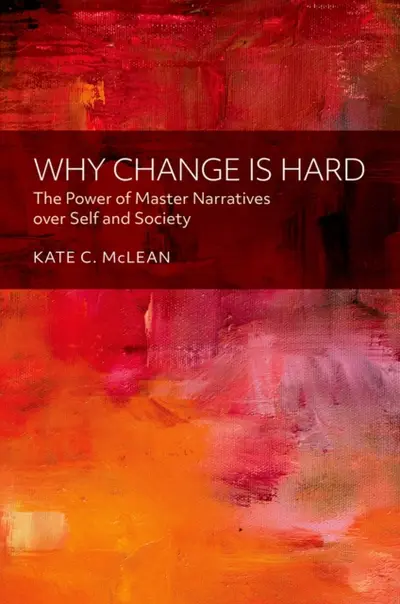
Why Change is Hard
The Power of Master Narratives over Self and Society
Price and availability
$62.99
Available in: Andorra, Austria, Australia, Belgium, Bulgaria, Canada, Switzerland, Cyprus, Czechia, Germany, Denmark, Estonia, Spain, Finland, France, United Kingdom, Guernsey, Greece, Croatia, Hungary, Ireland, Isle of Man, Iceland, Italy, Jersey, Japan, Liechtenstein, Lithuania, Luxembourg, Latvia, Monaco, Malta, Netherlands, Norway, Poland, Portugal, Romania, Sweden, Slovenia, Slovakia, San Marino, United States, Vatican City, South Africa
Stores: US, UK, Canada, EU, Australia.
Sign in to buyThe price is re-checked by the server before payment.
For personal use under the eBook licence.
- Format
- EPUB
- DRM
- Not stated by the publisher
- Language
- English
- Publisher
- Oxford University Press
- Published
- 16 February 2024
- ISBN
- 9780197764664
- Subjects
- Child & developmental psychology, Social, group or collective psychology, Child, developmental and lifespan psychology, Social, group or collective psychology
About this book
The possibilities of personal growth and change are embedded in American cultural values that center individual autonomy and personal responsibility for charting one's life course. These values infuse the scientific study of identity development, where scholarship has contributed to the idea that we are the sole authors of our own stories. However, the data to support such claims are sparse. In Why Change is Hard, Kate C. McLean argues that the promise of the possibility for growth and change, and the personal capacity to do so, are represented in problematic master narratives--present in broader society, as well as in the scientific community. Such narratives about personal growth and responsibility serve to limit attention to the systems and structures of society that restrict and deny the expression of individual identities, resulting in the maintenance of an inequitable status quo. The argument is made through the prism of the science on personality development, and narrative identity development in particular. This book calls into question the degree to which the theories and methods employed, as well as the data, support the elevation of such master narratives about the possibility for growth, challenging scholars to develop an awareness of their complicity in the maintenance of harmful ideologies.
Bibliographic data © Gardners Books Ltd.