PDF · English
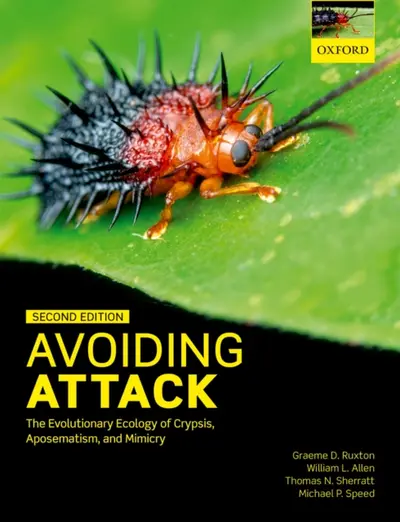
Avoiding Attack
The Evolutionary Ecology of Crypsis, Aposematism, and Mimicry
Price and availability
$58.99
Available in: Andorra, Austria, Australia, Belgium, Bulgaria, Canada, Switzerland, Cyprus, Czechia, Germany, Denmark, Estonia, Spain, Finland, France, United Kingdom, Guernsey, Greece, Croatia, Hungary, Ireland, Isle of Man, Iceland, Italy, Jersey, Japan, Liechtenstein, Lithuania, Luxembourg, Latvia, Monaco, Malta, Netherlands, Norway, Poland, Portugal, Romania, Sweden, Slovenia, Slovakia, San Marino, United States, Vatican City, South Africa
Stores: US, UK, Canada, EU, Australia.
Sign in to buyThe price is re-checked by the server before payment.
For personal use under the eBook licence.
- Format
- DRM
- Not stated by the publisher
- Language
- English
- Publisher
- Oxford University Press
- Published
- 31 January 2019
- ISBN
- 9780191002632
- Subjects
- Evolution, Genetics (non-medical), Zoology & animal sciences, Animal physiology, Animal behaviour, Evolution / Evolutionary biology, Genetics (non-medical), Ethology and animal behaviour
About this book
Avoiding Attack discusses the diversity of mechanisms by which prey avoid predator attacks and explores how such defensive mechanisms have evolved through natural selection. It considers how potential prey avoid detection, how they make themselves unprofitable to attack, how they communicate this status, and how other species have exploited these signals. Using carefully selected examples of camouflage, mimicry, and warning signals drawn from a wide range of species and ecosystems, the authors summarise the latest research into these fascinating adaptations, developing mathematical models where appropriate and making recommendations for future study. This second edition has been extensively rewritten, particularly in the application of modern genetic research techniques which have transformed our recent understanding of adaptations in evolutionary genomics and phylogenetics. The book also employs a more integrated and systematic approach, ensuring that each chapter has a broader focus on the evolutionary and ecological consequences of anti-predator adaptation. The field has grown and developed considerably over the last decade with an explosion of new research literature, making this new edition timely.
Bibliographic data © Gardners Books Ltd.