EPUB · English
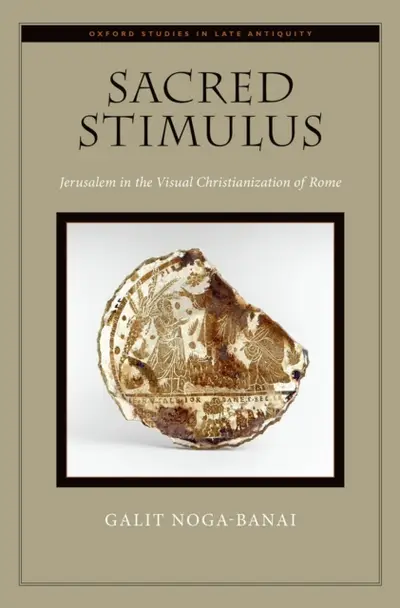
Sacred Stimulus
Jerusalem in the Visual Christianization of Rome
Price and availability
$75.99
Available in: Andorra, Austria, Australia, Belgium, Bulgaria, Canada, Switzerland, Cyprus, Czechia, Germany, Denmark, Estonia, Spain, Finland, France, United Kingdom, Guernsey, Greece, Croatia, Hungary, Ireland, Isle of Man, Iceland, Italy, Jersey, Japan, Liechtenstein, Lithuania, Luxembourg, Latvia, Monaco, Malta, Netherlands, Norway, Poland, Portugal, Romania, Sweden, Slovenia, Slovakia, San Marino, United States, Vatican City, South Africa
Stores: US, UK, Canada, EU, Australia.
Sign in to buyThe price is re-checked by the server before payment.
For personal use under the eBook licence.
- Format
- EPUB
- DRM
- Not stated by the publisher
- Language
- English
- Publisher
- Oxford University Press
- Published
- 1 June 2018
- ISBN
- 9780190874674
- Subjects
- Ancient Rome, History of art: ancient & classical art,BCE to c 500 CE, Ancient history: to c 500 CE, History of religion, Christianity, 1QBAR, AGA, NHC, QRAX, QRM
About this book
Sacred Stimulus offers a thorough exploration of Jerusalem's role in the formation and formulation of Christian art in Rome during the fourth and fifth centuries. The visual vocabulary discussed by Galit Noga-Banai gives an alternative access point to the mnemonic efforts conceived while Rome converted to Christianity: not in comparison to pagan art in Rome, not as reflecting the struggle with the emergence of New Rome in the East (Constantinople), but rather as visual expressions of the confrontation with earthly Jerusalem and its holy places. After all, Jerusalem is where the formative events of Christianity occurred and were memorialized. Sacred Stimulus argues that, already in the second half of the fourth century, Rome constructed its own set of holy sites and foundational myths, while expropriating for its own use some of Jerusalem's sacred relics, legends, and sites. Relying upon well-known and central works of art, including mosaic decoration, sarcophagi, wall paintings, portable art, and architecture, Noga-Banai exposes the omnipresence of Jerusalem and its position in the genesis of Christian art in Rome. Noga-Banai's consideration of earthly Jerusalem as a conception that Rome used, or had to take into account, in constructing its own new Christian ideological and cultural topography of the past, sheds light on connections and analogies that have not necessarily been preserved in the written evidence, and offers solutions to long-standing questions regarding specific motifs and scenes.
Bibliographic data © Gardners Books Ltd.