PDF · English
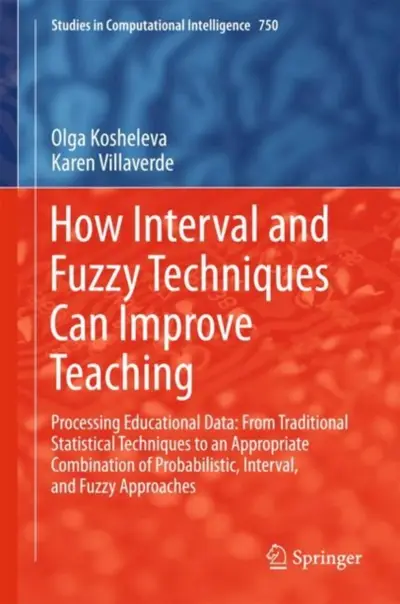
How Interval and Fuzzy Techniques Can Improve Teaching
Processing Educational Data: From Traditional Statistical Techniques to an Appropriate Combination of Probabilistic, Interval, and Fuzzy Approaches
Price and availability
$120.99
Available in: Andorra, Austria, Australia, Belgium, Bulgaria, Canada, Switzerland, Cyprus, Czechia, Germany, Denmark, Estonia, Spain, Finland, France, United Kingdom, Guernsey, Greece, Croatia, Hungary, Ireland, Isle of Man, Iceland, Italy, Jersey, Japan, Liechtenstein, Lithuania, Luxembourg, Latvia, Monaco, Malta, Netherlands, Norway, Poland, Portugal, Romania, Sweden, Slovenia, Slovakia, San Marino, United States, Vatican City, South Africa
Stores: US, UK, Canada, EU, Australia.
Sign in to buyThe price is re-checked by the server before payment.
For personal use under the eBook licence.
- Format
- DRM
- Not stated by the publisher
- Language
- English
- Publisher
- Springer Berlin Heidelberg
- Published
- 23 October 2017
- ISBN
- 9783662559932
- Subjects
- E-commerce: business aspects, Knowledge management, Business mathematics & systems, Engineering: general, Business applications, Artificial intelligence, E-commerce: business aspects, Business mathematics and systems, Business applications, Computer applications in the social and behavioural sciences, Artificial intelligence (AI)
About this book
This book explains how to teach better and presents the latest research on processing educational data and presents traditional statistical techniques as well as probabilistic, interval, and fuzzy approaches. Teaching is a very rewarding activity; it is also a very difficult one - because it is largely an art. There is a lot of advice on teaching available, but it is usually informal and is not easy to follow. To remedy this situation, it is reasonable to use techniques specifically designed to handle such imprecise knowledge: the fuzzy logic techniques. Since there are a large number of statistical studies of different teaching techniques, the authors combined statistical and fuzzy approaches to process the educational data in order to provide insights into improving all the stages of the education process: from forming a curriculum to deciding in which order to present the material to grading the assignments and exams. The authors do not claim to have solved all the problems of education. Instead they show, using numerous examples, that an innovative combination of different uncertainty techniques can improve teaching. The book offers teachers and instructors valuable advice and provides researchers in pedagogical and fuzzy areas with techniques to further advance teaching.
Bibliographic data © Gardners Books Ltd.