PDF · English
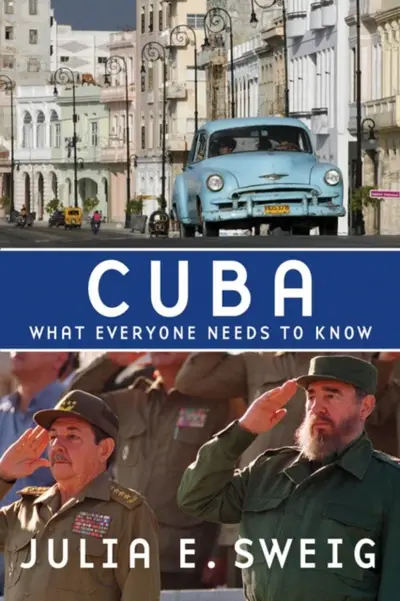
Cuba
What Everyone Needs to Know
Price and availability
$32.99
Available in: Andorra, Austria, Australia, Belgium, Bulgaria, Canada, Switzerland, Cyprus, Czechia, Germany, Denmark, Estonia, Spain, Finland, France, United Kingdom, Guernsey, Greece, Croatia, Hungary, Ireland, Isle of Man, Iceland, Italy, Jersey, Japan, Liechtenstein, Lithuania, Luxembourg, Latvia, Monaco, Malta, Netherlands, Norway, Poland, Portugal, Romania, Sweden, Slovenia, Slovakia, San Marino, United States, Vatican City, South Africa
Stores: US, UK, Canada, EU, Australia.
Sign in to buyThe price is re-checked by the server before payment.
For personal use under the eBook licence.
- Format
- DRM
- Not stated by the publisher
- Language
- English
- Publisher
- Oxford University Press
- Published
- 17 July 2009
- ISBN
- 9780199724918
- Subjects
- Cuba, Latin America, History of the Americas, Politics & government, Comparative politics, Marxism & Communism, Cuba, Latin America – Mexico, Central America, South America, Politics and government, Comparative politics, Far-left political ideologies and movements, NHK
About this book
Ever since Fidel Castro assumed power in Cuba in 1959, Americans have obsessed about the nation ninety miles south of the Florida Keys. America's fixation on the tropical socialist republic has only grown over the years, fueled in part by successive waves of Cuban immigration and Castro's larger-than-life persona. Cubans are now a major ethnic group in Florida, and the exile community is so powerful that every American president has kowtowed to it. But what do most Americans really know about Cuba itself?In Cuba: What Everyone Needs to Know, Julia Sweig, one of America's leading experts on Cuba and Latin America, presents a concise and remarkably accessible portrait of the small island nation's unique place on the world stage over the past fifty years. Yet it is authoritative as well. Following a scene-setting introduction that describes the dynamics unleashed since summer 2006 when Fidel Castro transferred provisional power to his brother Raul, the book looks backward toward Cuba's history since the Spanish American War before shifting to more recent times. Focusing equally on Cuba's role in world affairs and its own social and political transformations, Sweig divides the book chronologically into the pre-Fidel era, the period between the 1959 revolution and the fall of the Soviet Union, the post-Cold War era, and-finally-the looming post-Fidel era. Informative, pithy, and lucidly written, it will serve as the best compact reference on Cuba's internal politics, its often fraught relationship with the United States, and its shifting relationship with the global community.
Bibliographic data © Gardners Books Ltd.