PDF · English
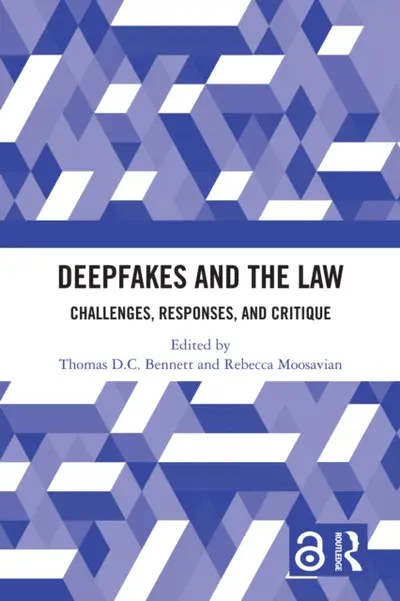
Deepfakes and the Law
Challenges, Responses, and Critique
Price and availability
$64.99
Available in: Andorra, Austria, Australia, Belgium, Bulgaria, Canada, Switzerland, Cyprus, Czechia, Germany, Denmark, Estonia, Spain, Finland, France, United Kingdom, Guernsey, Greece, Croatia, Hungary, Ireland, Isle of Man, Iceland, Italy, Jersey, Japan, Liechtenstein, Lithuania, Luxembourg, Latvia, Monaco, Malta, Netherlands, Norway, Poland, Portugal, Romania, Sweden, Slovenia, Slovakia, San Marino, United States, Vatican City, South Africa
Stores: US, UK, Canada, EU, Australia.
Sign in to buyThe price is re-checked by the server before payment.
For personal use under the eBook licence.
- Format
- DRM
- Not stated by the publisher
- Language
- English
- Publisher
- Taylor & Francis
- Published
- 1 September 2026
- ISBN
- 9781040542378
- Subjects
- Cultural studies, Media studies, Criminology: legal aspects, Criminal law & procedure, Entertainment & media law, IT & Communications law, Social law, Legal aspects of IT, Computer fraud & hacking, Computer science, Law and society, sociology of law, Privacy and data protection, Artificial intelligence (AI)
About this book
This collection offers the first sustained, multidisciplinary legal analysis of deepfakes and their far reaching consequences.Deepfake technology has moved with disorienting speed from fringe curiosity to a global social, political, and legal problem. Once the preserve of Hollywood studios, the ability to fabricate hyper realistic images, audio, and video is now available to anyone with a smartphone. Its most prevalent and devastating use remains the creation of non consensual sexually explicit content targeting women. Yet deepfakes also fuel political disinformation, destabilise democratic processes, enable fraud and identity theft, and contribute to a broader post truth climate in which the authenticity of all digital evidence becomes contestable. In this landscape, one of the most urgent tasks is simply to begin the right conversations about how law and society should respond. Across three sections, various international scholars examine how synthetic media challenges foundational assumptions about privacy, image rights, evidential truth, and democratic integrity. These essays explore deepfakes' profound impact on the individual dignity of both the living and the dead, their capacity to generate epistemic uncertainty, and the structural difficulties they pose for courts, regulators, and lawmakers. Bringing together theoretical, doctrinal, and comparative insights, the book illuminates a fragmented regulatory landscape and articulates both the pressing need for more coherent, principled governance of synthetic media, and some of the difficulties that will necessarily be encountered by those designing regulatory measures.This is a timely and vital volume for scholars, jurists, and legislators concerned with the future of truth, autonomy, and accountability in an increasingly synthetic world.
Bibliographic data © Gardners Books Ltd.