EPUB · English
Freemasonry and Kabbalah
The Masonic-Kabbalistic Art of Rabbi David Rosenberg
Price and availability
$76.99
Available in: Andorra, Austria, Australia, Belgium, Bulgaria, Canada, Switzerland, Cyprus, Czechia, Germany, Denmark, Estonia, Spain, Finland, France, United Kingdom, Guernsey, Greece, Croatia, Hungary, Ireland, Isle of Man, Iceland, Italy, Jersey, Japan, Liechtenstein, Lithuania, Luxembourg, Latvia, Monaco, Malta, Netherlands, Norway, Poland, Portugal, Romania, Sweden, Slovenia, Slovakia, San Marino, United States, Vatican City, South Africa
Stores: US, UK, Canada, EU, Australia.
Sign in to buyThe price is re-checked by the server before payment.
For personal use under the eBook licence.
- Format
- EPUB
- DRM
- Not stated by the publisher
- Language
- English
- Publisher
- Oxford University Press
- Published
- 23 October 2026
- ISBN
- 9780197788318
- Subjects
- Europe, Religious subjects depicted in art, Judaism, Mysticism, magic & ritual, Religious and ceremonial arts, QRJ, Mysticism, magic and alternative spiritual practices
About this book
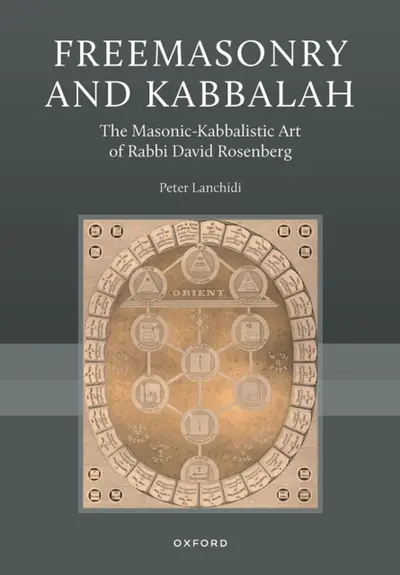
David Rosenberg, a Freemason rabbi and artist active in the Paris of the July Monarchy (1830 to 1848), was creatively inspired by the unlikely combination of two intellectual traditions within the realm of Western esotericism: Freemasonry and Kabbalah. In his chosen medium of uvre, Rosenberg innovatively combined Masonic and Kabbalistic visual and textual traditions, such as Masonic tracing boards and general symbolic charts, the Torah ark architecture, the designs of mizrach table, and the Kabbalistic tree. In Freemasonry and Kabbalah: The Masonic-Kabbalistic Art of Rabbi David Rosenberg, Peter Lanchidi uses Rosenberg's remarkable Masonic-Kabbalistic artworks to provide insight into how Kabbalah was perceived and utilised within Freemasonry, and how the Jewish visual heritage of Eastern Europe and Kabbalistic traditions were integrated into Western Masonic science and art. Lanchidi's extensive research on Rosenberg's uvre and its reception history conducted in over one hundred archives, collections, libraries, and museums across fifteen countries on four continents, will ultimately lead readers to a deeper understanding of cultural exchange and cross-fertilization in nineteenth-century Europe. Richly illustrated and historically contextualised, this book meets the growing scholarly and public interest in the visual dimensions of Western esotericism.
Bibliographic data © Gardners Books Ltd.