PDF · English
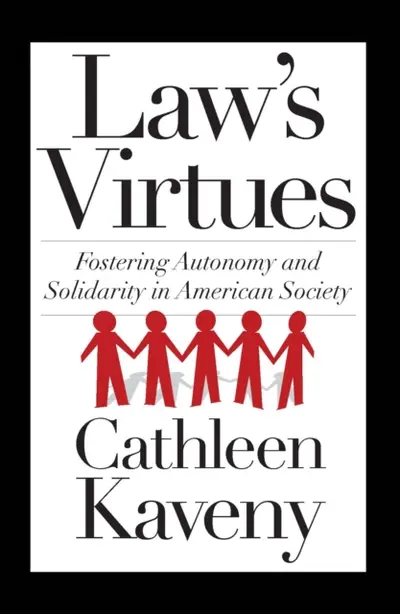
Law's Virtues
Fostering Autonomy and Solidarity in American Society
Price and availability
$64.99
Available in: Andorra, Austria, Australia, Belgium, Bulgaria, Canada, Switzerland, Cyprus, Czechia, Germany, Denmark, Estonia, Spain, Finland, France, United Kingdom, Guernsey, Greece, Croatia, Hungary, Ireland, Isle of Man, Iceland, Italy, Jersey, Japan, Liechtenstein, Lithuania, Luxembourg, Latvia, Monaco, Malta, Netherlands, Norway, Poland, Portugal, Romania, Sweden, Slovenia, Slovakia, San Marino, United States, Vatican City, South Africa
Stores: US, UK, Canada, EU, Australia.
Sign in to buyThe price is re-checked by the server before payment.
For personal use under the eBook licence.
- Format
- DRM
- Not stated by the publisher
- Language
- English
- Publisher
- Georgetown University Press
- Published
- 20 September 2012
- ISBN
- 9781589019331
- Subjects
- Ethics & moral philosophy, Roman Catholicism, Roman Catholic Church, Jurisprudence & philosophy of law, Law & society, Christianity, Roman Catholicism, Roman Catholic Church
About this book
<p>Can the law promote moral values even in pluralistic societies such as the United States? Drawing upon important federal legislation such as the Americans with Disabilities Act, legal scholar and moral theologian Cathleen Kaveny argues that it can. In conversation with thinkers as diverse as Thomas Aquinas, Pope John Paul II, and Joseph Raz, she argues that the law rightly promotes the values of autonomy and solidarity. At the same time, she cautions that wise lawmakers will not enact mandates that are too far out of step with the lived moral values of the actual community. </p><p>According to Kaveny, the law is best understood as a moral teacher encouraging people to act virtuously, rather than a police officer requiring them to do so. In <I>Law's Virtues</I> Kaveny expertly applies this theoretical framework to the controversial moral-legal issues of abortion, genetics, and euthanasia. In addition, she proposes a moral analysis of the act of voting, in dialogue with the election guides issued by the US bishops. Moving beyond the culture wars, this bold and provocative volume proposes a vision of the relationship of law and morality that is realistic without being relativistic and optimistic without being utopian.</p>
Bibliographic data © Gardners Books Ltd.