PDF · English
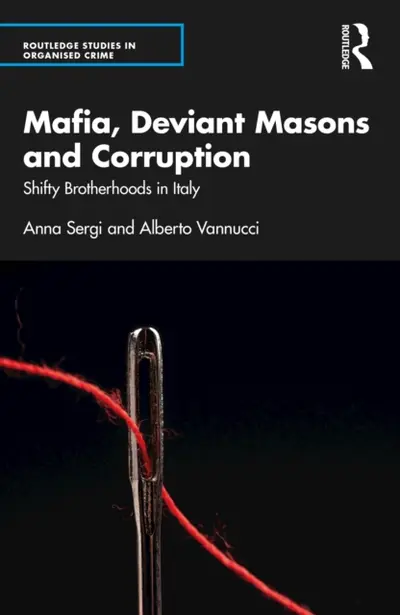
Mafia, Deviant Masons and Corruption
Shifty Brotherhoods in Italy
Price and availability
$58.99
Available in: Andorra, Austria, Australia, Belgium, Bulgaria, Canada, Switzerland, Cyprus, Czechia, Germany, Denmark, Estonia, Spain, Finland, France, United Kingdom, Guernsey, Greece, Croatia, Hungary, Ireland, Isle of Man, Iceland, Italy, Jersey, Japan, Liechtenstein, Lithuania, Luxembourg, Latvia, Monaco, Malta, Netherlands, Norway, Poland, Portugal, Romania, Sweden, Slovenia, Slovakia, San Marino, United States, Vatican City, South Africa
Stores: US, UK, Canada, EU, Australia.
Sign in to buyThe price is re-checked by the server before payment.
For personal use under the eBook licence.
- Format
- DRM
- Not stated by the publisher
- Language
- English
- Publisher
- Taylor & Francis
- Published
- 29 May 2023
- ISBN
- 9781000877281
- Subjects
- Italy, True crime, Social issues & processes, Violence in society, Freemasonry & secret societies, Sociology, Crime & criminology, Corporate crime, Organized crime, Politics & government, Criminology: legal aspects, Secret societies, Organized crime, Corruption in politics, government and society
About this book
This book is the first to consider the intersection between mafia power and deviant masonic lodges within the political sphere of the contemporary Italian state. At its core, it offers an analysis of the shifting interactions across powerful actors and the ways in which they balance reciprocal obedience, and a unique insight into the political processes where mafia actors and deviant lodges play a significant role in the allocation of resources.Mafia, Deviant Masons and Corruption draws on a wealth of literature from across criminology and political science and a range of primary data sources including judicial files, indictments, arrest warrants, intercepted materials and sentences for key cases, official documentation from Parliamentary commissions and special committees of inquiry, rituals of affiliation and codes of initiation, and interviews with prosecutors, journalists and experts. In doing so it redefines how we have come to understand the relationship between mafias and power in Italy. It considers how criminal groups are defined and enriched by a relational capital in shifty environments where every actor assumes often a double nature: the mafia boss acts as an entrepreneur; the entrepreneur acts as a politician; the politician mixes with masons; a deviant mason supports mafia organisations. This book is a major contribution to the literature on mafias and organised crime across criminology, sociology and political science, and will be of great interest to students, researchers, scholars, and engaged general readers.
Bibliographic data © Gardners Books Ltd.