PDF · English
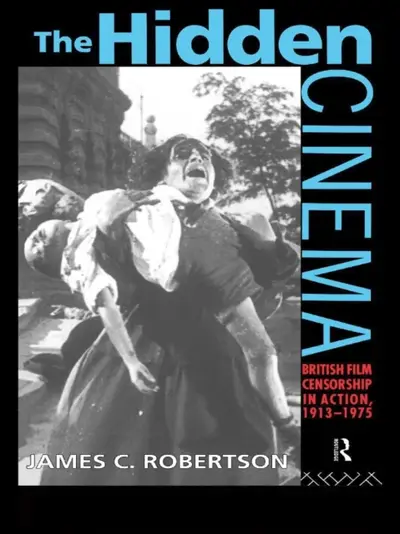
Hidden Cinema
British Film Censorship in Action 1913-1972
Price and availability
$58.99
Available in: Andorra, Austria, Australia, Belgium, Bulgaria, Canada, Switzerland, Cyprus, Czechia, Germany, Denmark, Estonia, Spain, Finland, France, United Kingdom, Guernsey, Greece, Croatia, Hungary, Ireland, Isle of Man, Iceland, Italy, Jersey, Japan, Liechtenstein, Lithuania, Luxembourg, Latvia, Monaco, Malta, Netherlands, Norway, Poland, Portugal, Romania, Sweden, Slovenia, Slovakia, San Marino, United States, Vatican City, South Africa
Stores: US, UK, Canada, EU, Australia.
Sign in to buyThe price is re-checked by the server before payment.
For personal use under the eBook licence.
- Format
- DRM
- Not stated by the publisher
- Language
- English
- Publisher
- Taylor & Francis
- Published
- 2 August 2005
- ISBN
- 9781134876723
- Subjects
- Films, cinema, Social & cultural history, Media studies, Ethical issues: censorship, United Kingdom, Great Britain, Film history, theory or criticism, Media studies
About this book
How does film censorship work in Britain? Jim Robertson's new paperback edition of The Hidden Cinema argues that censorship has had a far greater influence on British film history than is often apparent, creating the `hidden cinema' of the title. Robertson charts the role of the British Board of Film Censors, established in 1913, and the histories of a variety of noteworthy films including Battleship Potemkin and No Orchids for Miss Blandish and revealing how censorship continues to exert a marked influence on many important films - like the controversial A Clockwork Orange - some of which have now vanished from British screens altogether. This edition includes a brand new section on Bernardo Bertolucci's Last Tango in Paris, immediately engulfed in censorship wrangles on its release in 1972.
Bibliographic data © Gardners Books Ltd.