EPUB · English
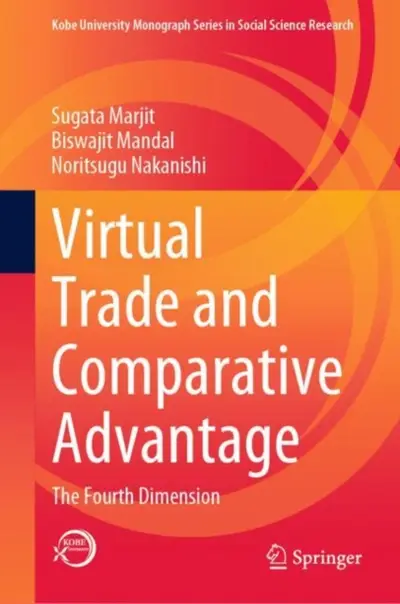
Virtual Trade and Comparative Advantage
The Fourth Dimension
Price and availability
$120.99
Available in: Andorra, Austria, Australia, Belgium, Bulgaria, Canada, Switzerland, Cyprus, Czechia, Germany, Denmark, Estonia, Spain, Finland, France, United Kingdom, Guernsey, Greece, Croatia, Hungary, Ireland, Isle of Man, Iceland, Italy, Jersey, Japan, Liechtenstein, Lithuania, Luxembourg, Latvia, Monaco, Malta, Netherlands, Norway, Poland, Portugal, Romania, Sweden, Slovenia, Slovakia, San Marino, United States, Vatican City, South Africa
Stores: US, UK, Canada, EU, Australia.
Sign in to buyThe price is re-checked by the server before payment.
For personal use under the eBook licence.
- Format
- EPUB
- DRM
- Not stated by the publisher
- Language
- English
- Publisher
- Springer Nature Singapore
- Published
- 9 April 2020
- ISBN
- 9789811539060
- Subjects
- Economics, Economic growth, International economics, Development economics & emerging economies, International business, Economics, Economic growth, International economics, Development economics and emerging economies
About this book
The main purpose of this book is to expose economics graduate students and researchers to the most significant development in international trade that has taken place in the recent past. Service transactions now make up a sizeable portion of global trade. Trade in both final and intermediate inputs is done virtually through information and communication networks, raising afresh the question of the basis of trade and calling for in-depth investigation. This book succinctly comes up with a relatively new explanation for the basis of trade, thus it adds a new dimension to three existing building blocks: technology, endowment, and returns to scale. Against a backdrop of standard Ricardian and Heckscher Ohlin competitive models of trade, the chapters of this book nicely introduce the issue of communication cost and the difference in time zones between two trading nations. Then follow many intricate phenomena such as informality, skill formation, growth, wage inequality, and decisions regarding foreign direct investment (FDI). However, imperfectly competitive models are not dealt with in great detail as they deserve more space than can be allotted to them here. Given the nonexistence of any research-oriented in-depth analyses of competitive trade models with time-zone differences, this book is a valuable addition to the resources available to researchers and policymakers interested in deciphering recent developments in global trade patterns and the subsequent welfare effect.
Bibliographic data © Gardners Books Ltd.