EPUB · English
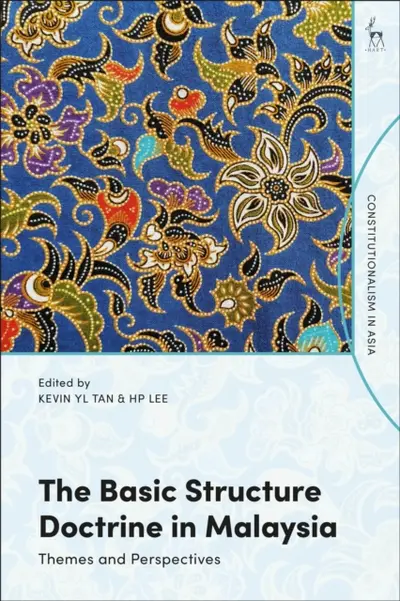
Basic Structure Doctrine in Malaysia
Themes and Perspectives
Price and availability
$115.99
Available in: Andorra, Austria, Australia, Belgium, Bulgaria, Canada, Switzerland, Cyprus, Czechia, Germany, Denmark, Estonia, Spain, Finland, France, United Kingdom, Guernsey, Greece, Croatia, Hungary, Ireland, Isle of Man, Iceland, Italy, Jersey, Japan, Liechtenstein, Lithuania, Luxembourg, Latvia, Monaco, Malta, Netherlands, Norway, Poland, Portugal, Romania, Sweden, Slovenia, Slovakia, San Marino, United States, Vatican City, South Africa
Stores: US, UK, Canada, EU, Australia.
Sign in to buyThe price is re-checked by the server before payment.
For personal use under the eBook licence.
- Format
- EPUB
- DRM
- Not stated by the publisher
- Language
- English
- Publisher
- Bloomsbury Publishing
- Published
- 10 July 2025
- Pages
- 312
- ISBN
- 9781509985517
- Subjects
- Malaysia, Comparative law, Constitutional & administrative law, Comparative law, Constitutional and administrative law: general
About this book
This book presents an in-depth interrogation of the theory and application of the Basic Structure Doctrine in the Federation of Malaysia.The Basic Structure Doctrine, famously introduced in the 1973 Indian Supreme decision of Kesavananda Bharati v State of Kerala AIR which held that certain core or fundamental features in the Constitution of India could not be amended by Parliament even if it met all procedural requirements was initially rejected when it was first argued in Malaysia in the 1975 case of Loh Kooi Choon v Government of Malaysia and lay dormant for the next three decades. Judicial winds shifted in 2010 when Malaysia's apex court, the Federal Court, cited Kesavananda with approval in the case of Sivarasa Rasiah v Badan Peguam Malaysia & Anor, and observed that it was 'clear from the way in which the Federal Constitution is constructed that there are certain features that constitute its basic fabric' and that 'any statute (including one amending the Constitution) that offends the basic structure may be struck down as unconstitutional.' In a quick succession of cases, the Federal Court cemented this doctrine in Malaysia's jurisprudence and deployed it to defend the court's judicial power. These widely-publicised cases generated much debate beyond the legal fraternity and judiciary and often polarised different sectors of Malaysian society. This collection of essays responds to this extremely important debate on the limits of constitutional amendments as a form of constitution-making in Malaysia by considering the theory behind the Basic Structure Doctrine and critically examining how it has been harnessed by the Federal Court and by other political actors most notably Islamists and secularists; and royalists and republicans on the ground.
Bibliographic data © Gardners Books Ltd.