PDF · English
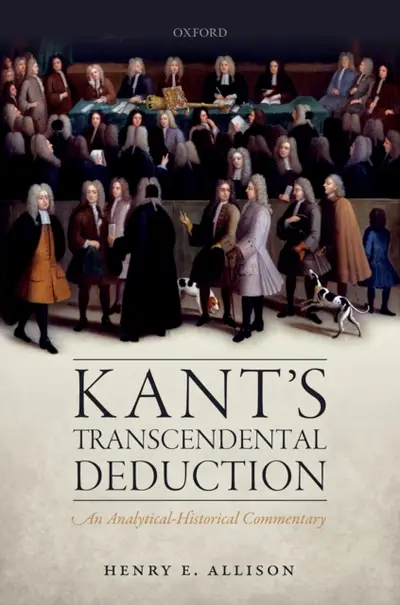
Kant's Transcendental Deduction
An Analytical-Historical Commentary
Price and availability
$52.99
Available in: Andorra, Austria, Australia, Belgium, Bulgaria, Canada, Switzerland, Cyprus, Czechia, Germany, Denmark, Estonia, Spain, Finland, France, United Kingdom, Guernsey, Greece, Croatia, Hungary, Ireland, Isle of Man, Iceland, Italy, Jersey, Japan, Liechtenstein, Lithuania, Luxembourg, Latvia, Monaco, Malta, Netherlands, Norway, Poland, Portugal, Romania, Sweden, Slovenia, Slovakia, San Marino, United States, Vatican City, South Africa
Stores: US, UK, Canada, EU, Australia.
Sign in to buyThe price is re-checked by the server before payment.
For personal use under the eBook licence.
- Format
- DRM
- Not stated by the publisher
- Language
- English
- Publisher
- Oxford University Press
- Published
- 18 June 2015
- ISBN
- 9780191037849
- Subjects
- History of Western philosophy, Western philosophy: Enlightenment, Philosophy: metaphysics & ontology, Philosophy: epistemology & theory of knowledge, Philosophy of mind, Philosophical traditions and schools of thought, Philosophy: metaphysics and ontology, Philosophy: epistemology and theory of knowledge, Philosophy of mind
About this book
Henry E. Allison presents an analytical and historical commentary on Kant`s transcendental deduction of the pure concepts of the understanding in the Critique of Pure Reason. He argues that, rather than providing a new solution to an old problem (refuting a global skepticism regarding the objectivity of experience), it addresses a new problem (the role of a priori concepts or categories stemming from the nature of the understanding in grounding this objectivity), and he traces the line of thought that led Kant to the recognition of the significance of this problem in his 'pre-critical' period. Allison locates four decisive steps in this process: the recognition that sensibility and understanding are distinct and irreducible cognitive powers, which Kant referred to as a 'great light' of 1769; the subsequent realization that, though distinct, these powers only yield cognition when they work together, which is referred to as the 'discursivity thesis' and which led directly to the distinction between analytic and synthetic judgments and the problem of the synthetic a priori; the discovery of the necessary unity of apperception as the supreme norm governing discursive cognition; and the recognition, through the influence of Tetens, of the role of the imagination in mediating between sensibility and understanding. In addition to the developmental nature of the account of Kant`s views, two distinctive features of Allison'sreading of the deduction are a defense of Kant`s oft criticized claim that the conformity of appearances to the categories must be unconditionally rather than merely conditionally necessary (the 'non-contingency thesis') and an insistence that the argument cannot be separated from Kant`s transcendental idealism (the 'non-separability thesis').
Bibliographic data © Gardners Books Ltd.