EPUB · English
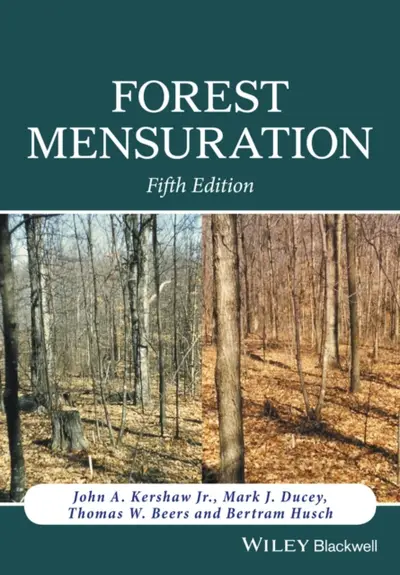
Forest Mensuration
Price and availability
$91.99
Available in: Andorra, Austria, Australia, Belgium, Bulgaria, Canada, Switzerland, Cyprus, Czechia, Germany, Denmark, Estonia, Spain, Finland, France, United Kingdom, Guernsey, Greece, Croatia, Hungary, Ireland, Isle of Man, Iceland, Italy, Jersey, Japan, Liechtenstein, Lithuania, Luxembourg, Latvia, Monaco, Malta, Netherlands, Norway, Poland, Portugal, Romania, Sweden, Slovenia, Slovakia, San Marino, United States, Vatican City, South Africa
Stores: US, UK, Canada, EU, Australia.
Sign in to buyThe price is re-checked by the server before payment.
For personal use under the eBook licence.
- Format
- EPUB
- DRM
- Not stated by the publisher
- Language
- English
- Publisher
- Wiley
- Published
- 1 November 2016
- ISBN
- 9781118902004
- Subjects
- Science: general issues, Forests, rainforests, Science: general issues, Forests and woodland
About this book
Forest mensuration the science of measurement applied to forest vegetation and forest products holds value for basic ecology as well as sustainable forest management. As demands on the world s forests have grown, scientists and professionals are increasingly called on to quantify forest composition, structure, and the goods and services forests provide. Grounded in geometry, sampling theory, and ecology as well as practical field experience, forest mensuration offers opportunities for creative problem solving and critical thinking. This fifth edition of the classic volume, Forest Mensuration, includes coverage of traditional and emerging topics, with attention to SI and Imperial units throughout. The book has been reorganised from the fourth edition to better integrate non-timber and ecological aspects of forest mensuration at the tree, stand, forest, and landscape scales throughout. The new edition includes new chapters that specifically address the integration of remotely sensed data in the forest inventory process, and inventory methods for dead and downed wood. One unifying theme, not only for traditional forestry but for the non-timber inventory and for remote sensing, is the use of covariates to make sampling more efficient and spatially explicit. This is introduced in the introductory chapter on statistics and the chapter on sampling designs has been restructured to highlight this approach and lay the foundation for further learning. New examples will be developed throughout the textbook with an emphasis on current issues and international practice. Students in applied forestry programs will find ample coverage of forest products and timber inventory, while expanded material on biodiversity, biomass and carbon inventory, downed dead wood, and the growing role of remote sensing in forest assessment will be valuable to a broader audience in applied ecology.
Bibliographic data © Gardners Books Ltd.