EPUB · English
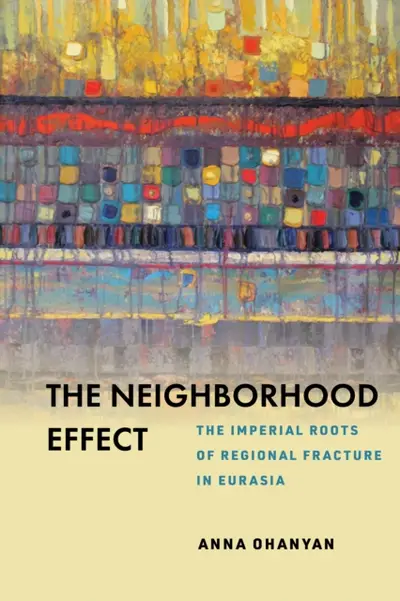
Neighborhood Effect
The Imperial Roots of Regional Fracture in Eurasia
Price and availability
$66.99
Available in: Andorra, Austria, Australia, Belgium, Bulgaria, Canada, Switzerland, Cyprus, Czechia, Germany, Denmark, Estonia, Spain, Finland, France, United Kingdom, Guernsey, Greece, Croatia, Hungary, Ireland, Isle of Man, Iceland, Italy, Jersey, Japan, Liechtenstein, Lithuania, Luxembourg, Latvia, Monaco, Malta, Netherlands, Norway, Poland, Portugal, Romania, Sweden, Slovenia, Slovakia, San Marino, United States, Vatican City, South Africa
Stores: US, UK, Canada, EU, Australia.
Sign in to buyThe price is re-checked by the server before payment.
For personal use under the eBook licence.
- Format
- EPUB
- DRM
- Not stated by the publisher
- Language
- English
- Publisher
- Stanford University Press
- Published
- 23 August 2022
- ISBN
- 9781503632066
- Subjects
- Europe, Eastern Europe, c 1800 to c 1900, Biography: historical, political & military, European history, Modern history to 20th century: c 1700 to c 1900, Social & cultural history, International relations, 3MN, DNBH, International relations, NH, NHD, NHTB
About this book
Why are certain regions of the world mired in conflict? And how did some regions in Eurasia emerge from the Cold War as peaceful and resilient? Why do conflicts ignite in Bosnia, Donbas, and Damascus-once on the peripheries of mighty empires-yet other postimperial peripheries like the Baltics or Central Europe enjoy quiet stability?Anna Ohanyan argues for the salience of the neighborhood effect: the complex regional connectivity among ethnic-religious communities that can form resilient regions. In an account of Eurasian regional formation that stretches back long before the nation-state, Ohanyan refutes the notion that stable regions are the luxury of prosperous, stable, democratic states. She examines case studies from regions once on the fringes of the Habsburg, Ottoman, and Russian Empires to find the often-overlooked patterns of bonding and bridging, or clustering and isolation of political power and social resources, that are associated with regional resilience or fracture in those regions today.With comparative examples from Latin America and Africa, The Neighborhood Effect offers a new explanation for the conflicts we are likely to see emerge as the unipolar US-led order dissolves, making the fractures in regional neighborhoods painfully evident. And it points the way to the future of peacebuilding: making space for the smaller links and connections that comprise a stable neighborhood.
Bibliographic data © Gardners Books Ltd.