PDF · English
Introduction to Aeroelasticity
Price and availability
$148.99
Available in: Andorra, Austria, Australia, Belgium, Bulgaria, Canada, Switzerland, Cyprus, Czechia, Germany, Denmark, Estonia, Spain, Finland, France, United Kingdom, Guernsey, Greece, Croatia, Hungary, Ireland, Isle of Man, Iceland, Italy, Jersey, Japan, Liechtenstein, Lithuania, Luxembourg, Latvia, Monaco, Malta, Netherlands, Norway, Poland, Portugal, Romania, Sweden, Slovenia, Slovakia, San Marino, United States, Vatican City, South Africa
Stores: US, UK, Canada, EU, Australia.
Sign in to buyThe price is re-checked by the server before payment.
For personal use under the eBook licence.
- Format
- DRM
- Not stated by the publisher
- Language
- English
- Publisher
- CRC Press
- Published
- 30 December 2024
- ISBN
- 9781040223369
- Subjects
- Applied mathematics, Fluid mechanics, Engineering: general, Mechanical engineering, Dynamics & vibration, Mechanics of fluids, Structural engineering, Environmental science, engineering & technology, Aerospace & aviation technology, Engineering: Mechanics of solids, Aerodynamics, Aerospace and aviation technology
About this book
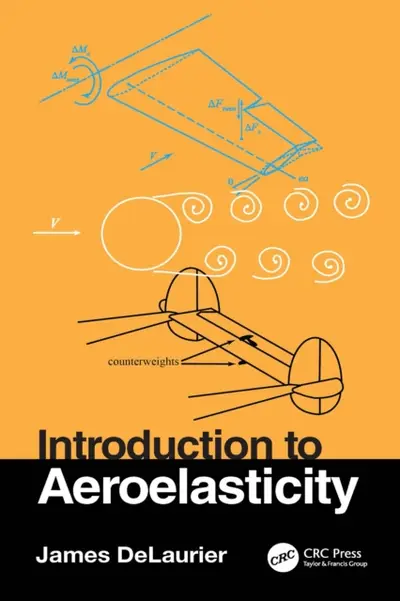
Introduction to Aeroelasticity introduces the classical topics of aeroelasticity, beginning with elastic structural modeling and the way that wing and tail structures can diverge and deform due to aerodynamic, inertial, and control-surface deflections.Flutter is then described, first with an airfoil example with increasing complexity, and then for flutter predictions of finite wings with and without control surfaces.Single-degree-of-freedom flutter is also discussed, which includes cable "e;galloping,"e; Aeolian flutter, as well as plunging and pitching stall flutter. In all cases, the equation derivations proceed in a step-by-step fashion, complemented by several numerical (and historical) examples.The book is intended to be a quantitative survey course for senior undergraduate and graduate students, as well as any engineer wishing a thorough introduction of the topic.Instructors will be able to utilize a Solutions Manual and figure slides for their course based upon this book.
Bibliographic data © Gardners Books Ltd.