PDF · English
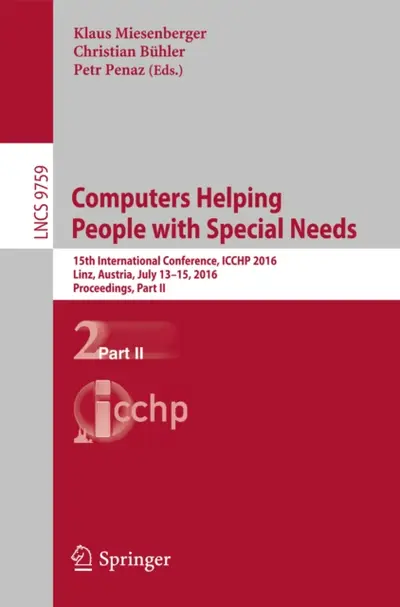
Computers Helping People with Special Needs
15th International Conference, ICCHP 2016, Linz, Austria, July 13-15, 2016, Proceedings, Part II
Price and availability
$60.99
Available in: Andorra, Austria, Australia, Belgium, Bulgaria, Canada, Switzerland, Cyprus, Czechia, Germany, Denmark, Estonia, Spain, Finland, France, United Kingdom, Guernsey, Greece, Croatia, Hungary, Ireland, Isle of Man, Iceland, Italy, Jersey, Japan, Liechtenstein, Lithuania, Luxembourg, Latvia, Monaco, Malta, Netherlands, Norway, Poland, Portugal, Romania, Sweden, Slovenia, Slovakia, San Marino, United States, Vatican City, South Africa
Stores: US, UK, Canada, EU, Australia.
Sign in to buyThe price is re-checked by the server before payment.
For personal use under the eBook licence.
- Format
- DRM
- Not stated by the publisher
- Language
- English
- Publisher
- Springer International Publishing
- Published
- 5 July 2016
- ISBN
- 9783319412672
- Subjects
- Disability: social aspects, Educational equipment & technology, computer-aided learning (CAL), Business applications, Information retrieval, Artificial intelligence, Human-computer interaction, User interface design & usability, Educational equipment and technology, computer-aided learning (CAL), Applied computing, Computer applications in the social and behavioural sciences, Artificial intelligence (AI), Human–computer interaction
About this book
The two volume set LNCS 9758 and 9759, constitutes the refereed proceedings of the 15th International Conference on Computers Helping People with Special Needs, ICCHP 2015, held in Linz, Austria, in July 2016.The 115 revised full papers and 48 short papers presented were carefully reviewed and selected from 239 submissions. The papers included in the second volume are organized in the following topics: environmental sensing technologies for visual impairments; tactile graphics and models for blind people and recognition of shapes by touch; tactile maps and map data for orientation and mobility; mobility support for blind and partially sighted people; the use of mobile devices by individuals with special needs as an assistive tool; mobility support for people with motor and cognitive disabilities; towards e-inclusion for people with intellectual disabilities; At and inclusion of people with autism or dyslexia; AT and inclusion of deaf and hard of hearing people; accessible computer input; AT and rehabilitation for people with motor and mobility disabilities; HCI, AT and ICT for blind and partially sighted people.
Bibliographic data © Gardners Books Ltd.