PDF · English
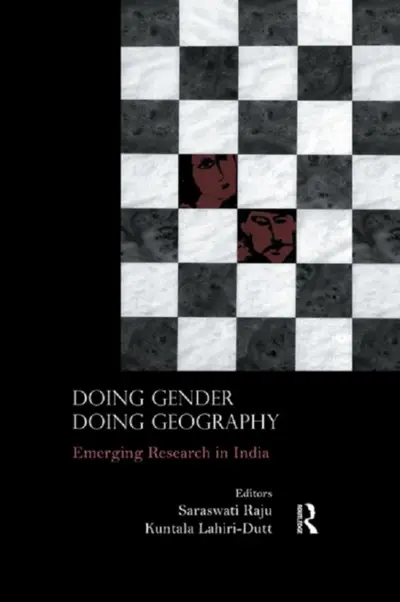
Doing Gender, Doing Geography
Emerging Research in India
Price and availability
$75.99
Available in: Andorra, Austria, Australia, Belgium, Bulgaria, Canada, Switzerland, Cyprus, Czechia, Germany, Denmark, Estonia, Spain, Finland, France, United Kingdom, Guernsey, Greece, Croatia, Hungary, Ireland, Isle of Man, Iceland, Italy, Jersey, Japan, Liechtenstein, Lithuania, Luxembourg, Latvia, Monaco, Malta, Netherlands, Norway, Poland, Portugal, Romania, Sweden, Slovenia, Slovakia, San Marino, United States, Vatican City, South Africa
Stores: US, UK, Canada, EU, Australia.
Sign in to buyThe price is re-checked by the server before payment.
For personal use under the eBook licence.
- Format
- DRM
- Not stated by the publisher
- Language
- English
- Publisher
- Taylor & Francis
- Published
- 6 December 2012
- ISBN
- 9781136197369
- Subjects
- Gender studies, gender groups, Social work, India, Population and migration geography, Social geography, Settlement, urban and rural geography
About this book
Until the 1970s gender had been invisible in analyses of social space and place in the androcentric discipline of geography. While recent contributions to feminist geography have challenged this, in India the engagement of geographers with gender, by being conservative in its choice of focus and orthodox in methodology, has been unable to destabilise the established disciplinary order. However, with younger scholars becoming increasingly interested in studying gender in geography, novel and innovative methods that include combinations of quantitative and qualitative analyses, visual sources and in-depth case studies are being tried out and accepted in geography despite its masculine legacy.This pioneering study brings together Indian geographers' contributions to understanding gender, and through them, seeks to enrich the discipline of geography. It engages with the recent 'spatial turn' in the social sciences, which has reclaimed the explanatory power of space and place in social theory that had been nearly lost to deconstructive postmodernist scholarship. The volume draws entirely from the Indian scholarship, showcasing contextualised knowledge production, but hopes to initiate a a dialogue with scholars elsewhere working with feminist methodologies.
Bibliographic data © Gardners Books Ltd.