PDF · English
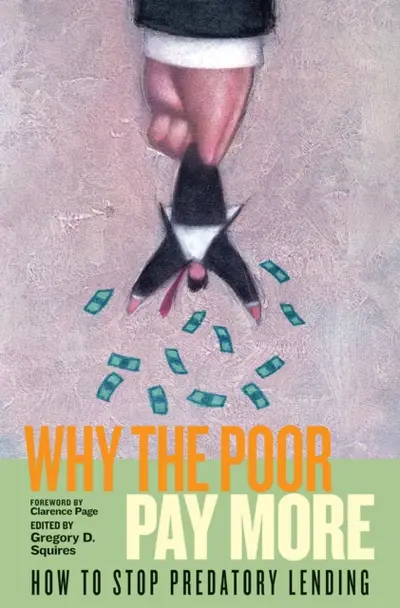
Why the Poor Pay More
How to Stop Predatory Lending
Price and availability
$90.99
Available in: Andorra, Austria, Australia, Belgium, Bulgaria, Canada, Switzerland, Cyprus, Czechia, Germany, Denmark, Estonia, Spain, Finland, France, United Kingdom, Guernsey, Greece, Croatia, Hungary, Ireland, Isle of Man, Iceland, Italy, Jersey, Japan, Liechtenstein, Lithuania, Luxembourg, Latvia, Monaco, Malta, Netherlands, Norway, Poland, Portugal, Romania, Sweden, Slovenia, Slovakia, San Marino, United States, Vatican City, South Africa
Stores: US, UK, Canada, EU, Australia.
Sign in to buyThe price is re-checked by the server before payment.
For personal use under the eBook licence.
- Format
- DRM
- Not stated by the publisher
- Language
- English
- Publisher
- Bloomsbury Publishing (USA)
- Published
- 30 October 2004
- Pages
- 248
- ISBN
- 9780313067907
- Subjects
- Society & culture: general, Economic theory & philosophy, Business & management, JB, Economic theory and philosophy, Business and Management
About this book
The proverbial American dream of owning a home has become an all-too-real nightmare for a growing number of families. The most vulnerable segments of our society-including minorities, the elderly, and working families-are being victimized by financiers who lure them into commitments they cannot fulfill. Collectively known as predatory lending, these practices include offering higher interest rates than can be justified by the risk, high pre-payment penalties that lock families into exploitative loans, and monstrous balloon payments that often result in default and the loss of the home. The net result can be disastrous: damage to one's credit rating, bankruptcy, and even the loss of lifelong savings.Why the Poor Pay More is an incisive exposure of these practices: how they have evolved, why they have become so prevalent in recent years, and how their negative effects can be quantified. It features in-depth analysis from prominent scholars, legal experts, and community leaders, who shed new light on the social, political, and economic consequences of predatory lending. Why the Poor Pay More is much more than an indictment of these insidious discriminatory practices. It is a call to arms for anyone concerned about how the financial-political system can be corrupted to serve the needs of the wealthy. Highlighting community initiatives already underway to combat predatory lending and an extensive listing of practical resources, Why the Poor Pay More outlines active roles that individuals, advocacy groups, financial and legal service providers, and policymakers can play in reversing this destructive trend.
Bibliographic data © Gardners Books Ltd.