EPUB · English
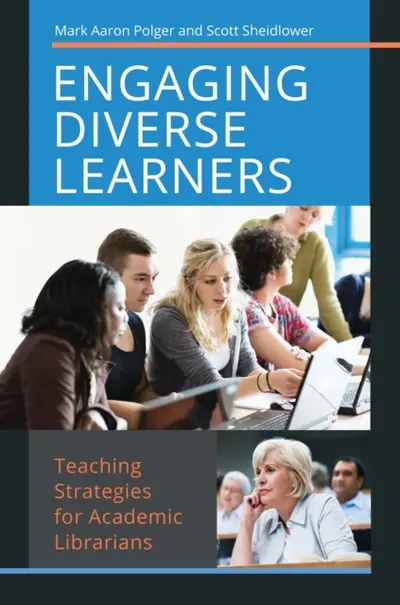
Engaging Diverse Learners
Teaching Strategies for Academic Librarians
Price and availability
$66.99
Available in: Andorra, Austria, Australia, Belgium, Bulgaria, Canada, Switzerland, Cyprus, Czechia, Germany, Denmark, Estonia, Spain, Finland, France, United Kingdom, Guernsey, Greece, Croatia, Hungary, Ireland, Isle of Man, Iceland, Italy, Jersey, Japan, Liechtenstein, Lithuania, Luxembourg, Latvia, Monaco, Malta, Netherlands, Norway, Poland, Portugal, Romania, Sweden, Slovenia, Slovakia, San Marino, United States, Vatican City, South Africa
Stores: US, UK, Canada, EU, Australia.
Sign in to buyThe price is re-checked by the server before payment.
For personal use under the eBook licence.
- Format
- EPUB
- DRM
- Not stated by the publisher
- Language
- English
- Publisher
- Bloomsbury Publishing (USA)
- Published
- 13 February 2017
- Pages
- 184
- ISBN
- 9798216079804
- Subjects
- Library & information sciences, Academic & specialist libraries, Teaching skills & techniques, Library and information sciences / Museology, GLM, Teaching skills and techniques
About this book
This book connects teaching practical strategies and ideas with educational theories to give you techniques to use in the classroom to capture students' attention and engage them with instruction.Drawing on the literatures of adult education and of teaching skills, Engaging Diverse Learners: Teaching Strategies for Academic Librarians presents a wide range of methods to improve how you teach. Coauthors Mark Aaron Polger and Scott Sheidlower argue that in order to grab-and hold onto-students' attention, instructors must get their interest right from the beginning. The techniques they suggest explain how to take into consideration the range of different learning styles students may have, how to accommodate students with different English language skills or abilities, and how to successfully work with individuals from different socioeconomic backgrounds or from different technologically adapted generations. The sections for each group address the key questions of identification (who are they?); how members of that group tend to react to libraries, librarians, and education; and how educational theories of that time affected students' learning in that generation.
Bibliographic data © Gardners Books Ltd.