EPUB · English
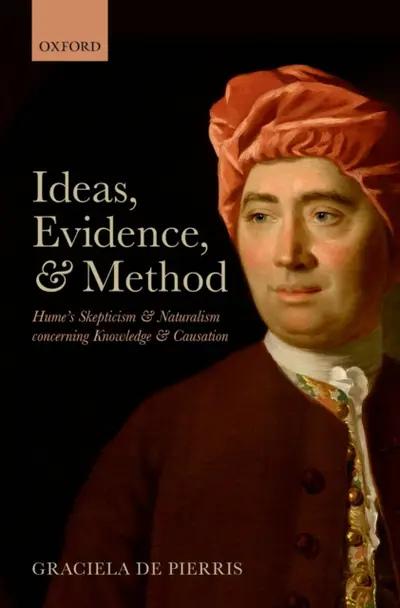
Ideas, Evidence, and Method
Hume's Skepticism and Naturalism concerning Knowledge and Causation
Price and availability
$91.99
Available in: Andorra, Austria, Australia, Belgium, Bulgaria, Canada, Switzerland, Cyprus, Czechia, Germany, Denmark, Estonia, Spain, Finland, France, United Kingdom, Guernsey, Greece, Croatia, Hungary, Ireland, Isle of Man, Iceland, Italy, Jersey, Japan, Liechtenstein, Lithuania, Luxembourg, Latvia, Monaco, Malta, Netherlands, Norway, Poland, Portugal, Romania, Sweden, Slovenia, Slovakia, San Marino, United States, Vatican City, South Africa
Stores: US, UK, Canada, EU, Australia.
Sign in to buyThe price is re-checked by the server before payment.
For personal use under the eBook licence.
- Format
- EPUB
- DRM
- Not stated by the publisher
- Language
- English
- Publisher
- Oxford University Press
- Published
- 30 April 2015
- ISBN
- 9780191057663
- Subjects
- Western philosophy: Medieval & Renaissance, c 500 to c 1600, Philosophy: epistemology & theory of knowledge, History of ideas, History of ideas, Medieval Western philosophy, Philosophy: epistemology and theory of knowledge
About this book
Graciela De Pierris presents a novel interpretation of the relationship between skepticism and naturalism in Hume's epistemology, and a new appraisal of Hume's place within early modern thought. Whereas a dominant trend in recent Hume scholarship maintains that there are no skeptical arguments concerning causation and induction in Book I, Part III of the Treatise, Graciela De Pierris presents a detailed reading of the skeptical argument she finds there and how this argument initiates a train of skeptical reasoning that begins in Part III and culminates in Part IV. This reasoning is framed by Hume's version of the modern theory of ideas developed by Descartes and Locke. The skeptical implications of this theory, however, do not arise, as in traditional interpretations of Hume's skepticism, from the 'veil of perception.' They arise from Hume's elaboration of a presentational-phenomenological model of ultimate evidence, according to which there is always a justificatory gap between what is or has been immediately presented to the mind and any ideas that go beyond it. This happens, paradigmatically, in the causal-inductive inference, and, as De Pierris argues, in demonstrative inference as well. Yet, in spite of his firm commitment to radical skepticism, Hume also accepts the naturalistic standpoint of science and common life, and he does so, on the novel interpretation presented here, because of an equally firm commitment to Newtonian science in general and the Newtonian inductive method in particular. Hume defends the Newtonian method (against the mechanical philosophy) while simultaneously rejecting all attempts (including those of the Newtonians) to find a place for the supernatural within our understanding of nature.
Bibliographic data © Gardners Books Ltd.