PDF · English
Singular Introduction to Commutative Algebra
Price and availability
$97.99
Available in: Andorra, Austria, Australia, Belgium, Bulgaria, Canada, Switzerland, Cyprus, Czechia, Germany, Denmark, Estonia, Spain, Finland, France, United Kingdom, Guernsey, Greece, Croatia, Hungary, Ireland, Isle of Man, Iceland, Italy, Jersey, Japan, Liechtenstein, Lithuania, Luxembourg, Latvia, Monaco, Malta, Netherlands, Norway, Poland, Portugal, Romania, Sweden, Slovenia, Slovakia, San Marino, United States, Vatican City, South Africa
Stores: US, UK, Canada, EU, Australia.
Sign in to buyThe price is re-checked by the server before payment.
For personal use under the eBook licence.
- Format
- DRM
- Not stated by the publisher
- Language
- English
- Publisher
- Springer Berlin Heidelberg
- Published
- 6 December 2012
- ISBN
- 9783662049631
- Subjects
- Groups & group theory, Mathematical theory of computation, Algebra, Numerical analysis, Algebraic geometry, Algorithms and data structures, Maths for computer scientists
About this book
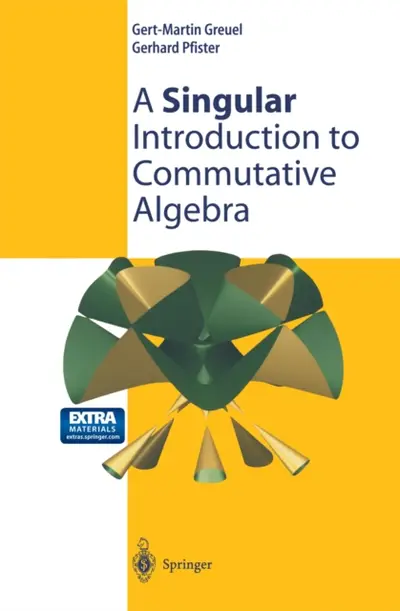
In theory there is no difference between theory and practice. In practice there is. Yogi Berra A SINGULAR Introduction to Commutative Algebra offers a rigorous intro- duction to commutative algebra and, at the same time, provides algorithms and computational practice. In this book, we do not separate the theoretical and the computational part. Coincidentally, as new concepts are introduced, it is consequently shown, by means of concrete examples and general proce- dures, how these concepts are handled by a computer. We believe that this combination of theory and practice will provide not only a fast way to enter a rather abstract field but also a better understanding of the theory, showing concurrently how the theory can be applied. We exemplify the computational part by using the computer algebra sys- tem SINGULAR, a system for polynomial computations, which was developed in order to support mathematical research in commutative algebra, algebraic geometry and singularity theory. As the restriction to a specific system is necessary for such an exposition, the book should be useful also for users of other systems (such as Macaulay2 and CoCoA) with similar goals. Indeed, once the algorithms and the method of their application in one system is known, it is usually not difficult to transfer them to another system.
Bibliographic data © Gardners Books Ltd.