PDF · English
Performing Chinatown
Hollywood, Tourism, and the Making of a Chinese American Community
Price and availability
$28.99
Available in: Andorra, Austria, Australia, Belgium, Bulgaria, Canada, Switzerland, Cyprus, Czechia, Germany, Denmark, Estonia, Spain, Finland, France, United Kingdom, Guernsey, Greece, Croatia, Hungary, Ireland, Isle of Man, Iceland, Italy, Jersey, Japan, Liechtenstein, Lithuania, Luxembourg, Latvia, Monaco, Malta, Netherlands, Norway, Poland, Portugal, Romania, Sweden, Slovenia, Slovakia, San Marino, United States, Vatican City, South Africa
Stores: US, UK, Canada, EU, Australia.
Sign in to buyThe price is re-checked by the server before payment.
For personal use under the eBook licence.
- Format
- DRM
- Not stated by the publisher
- Language
- English
- Publisher
- Stanford University Press
- Published
- 14 May 2024
- ISBN
- 9781503639096
- Subjects
- USA, Western & Pacific Coast states, Film theory & criticism, History of the Americas, Social & cultural history, Ethnic studies, Black & Asian studies, United States of America, USA, 1KBB-US-W, ATFA, JBSL, NHK, NHTB
About this book
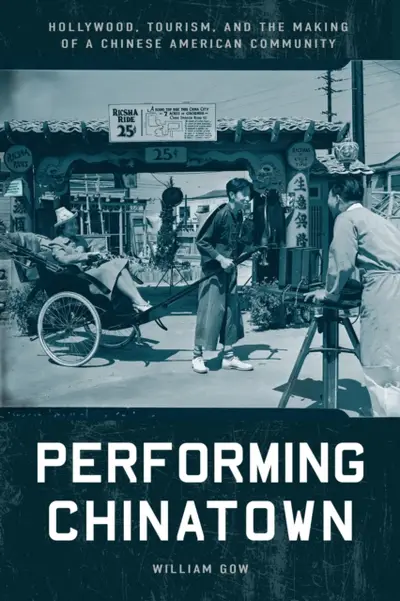
In 1938, China City opened near downtown Los Angeles. Featuring a recreation of the House of Wang set from MGM's The Good Earth, this new Chinatown employed many of the same Chinese Americans who performed as background extras in the 1937 film. Chinatown and Hollywood represented the two primary sites where Chinese Americans performed racial difference for popular audiences during the Chinese exclusion era. In Performing Chinatown, historian William Gow argues that Chinese Americans in Los Angeles used these performances in Hollywood films and in Chinatown for tourists to shape widely held understandings of race and national belonging during this pivotal chapter in U.S. history. Performing Chinatown conceives of these racial representations as intimately connected to the restrictive immigration laws that limited Chinese entry into the U.S. beginning with the 1875 Page Act and continuing until the passage of the Immigration and Nationality Act of 1965. At the heart of this argument are the voices of everyday people including Chinese American movie extras, street performers, and merchants. Drawing on more than 40 oral history interviews as well as research in more than a dozen archival and family collections, this book retells the long-overlooked history of the ways that Los Angeles Chinatown shaped Hollywood and how Hollywood, in turn, shaped perceptions of Asian American identity.
Bibliographic data © Gardners Books Ltd.