PDF · English
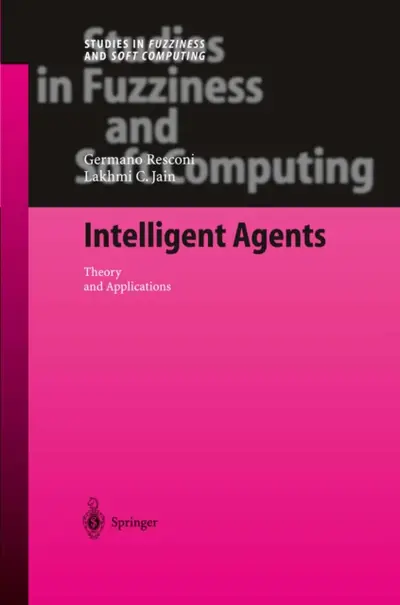
Intelligent Agents
Theory and Applications
Price and availability
$175.99
Available in: Andorra, Austria, Australia, Belgium, Bulgaria, Canada, Switzerland, Cyprus, Czechia, Germany, Denmark, Estonia, Spain, Finland, France, United Kingdom, Guernsey, Greece, Croatia, Hungary, Ireland, Isle of Man, Iceland, Italy, Jersey, Japan, Liechtenstein, Lithuania, Luxembourg, Latvia, Monaco, Malta, Netherlands, Norway, Poland, Portugal, Romania, Sweden, Slovenia, Slovakia, San Marino, United States, Vatican City, South Africa
Stores: US, UK, Canada, EU, Australia.
Sign in to buyThe price is re-checked by the server before payment.
For personal use under the eBook licence.
- Format
- DRM
- Not stated by the publisher
- Language
- English
- Publisher
- Springer Berlin Heidelberg
- Published
- 9 March 2013
- ISBN
- 9783540444015
- Subjects
- Information theory, Applied mathematics, Engineering: general, Artificial intelligence, Information theory, Coding theory and cryptology, Applied mathematics, Maths for engineers, Artificial intelligence (AI)
About this book
This research book presents the agent theory and adaptation of agents in different contexts. Agents of different orders of complexity must be autonomous in the rules used. The agent must have a brain by which it can discover rules contained within the data. Because rules are the instruments by which agents change the environment, any adaptation of the rules can be considered as an evolution of the agents. Because uncertainty is present in every context, we shall describe in this book how it is possible to introduce global uncertainty from the local world into the description of the rules. This book contains ten chapters. Chapter 1 gives a general dscription of the evolutionary adaptation agent. Chapter 2 describes the actions and meta- actions of the agent at different orders. Chapter 3 presents in an abstract and formal way the actions at different orders. Chapter 4 connects systems and meta systems with the adaptive agent. Chapter 5 describes the brain of the agent by the morphogenetic neuron theory. Chapter 6 introduces the logic structure of the adaptive agent. Chapter 7 describes the feedback and hyper-feedback in the adaptive agent. Chapter 8 introduces the adaptation field into the modal logic space as logic instrument in the adaptive agent. Chapter 9 describes the action of the agent in the physical domain. Chapter 10 presents the practical application of agents in robots and evolutionary computing.
Bibliographic data © Gardners Books Ltd.