PDF · English
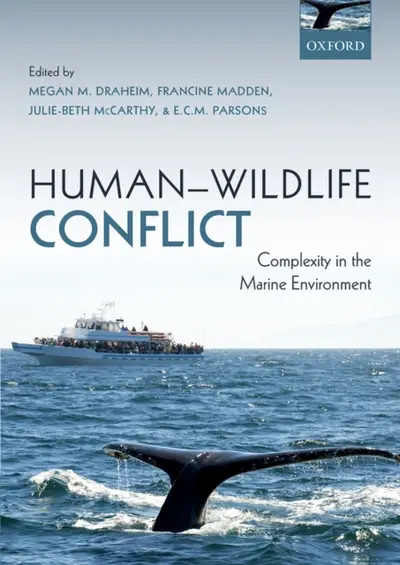
Human-Wildlife Conflict
Complexity in the Marine Environment
Price and availability
$67.99
Available in: Andorra, Austria, Australia, Belgium, Bulgaria, Canada, Switzerland, Cyprus, Czechia, Germany, Denmark, Estonia, Spain, Finland, France, United Kingdom, Guernsey, Greece, Croatia, Hungary, Ireland, Isle of Man, Iceland, Italy, Jersey, Japan, Liechtenstein, Lithuania, Luxembourg, Latvia, Monaco, Malta, Netherlands, Norway, Poland, Portugal, Romania, Sweden, Slovenia, Slovakia, San Marino, United States, Vatican City, South Africa
Stores: US, UK, Canada, EU, Australia.
Sign in to buyThe price is re-checked by the server before payment.
For personal use under the eBook licence.
- Format
- DRM
- Not stated by the publisher
- Language
- English
- Publisher
- Oxford University Press
- Published
- 30 July 2015
- ISBN
- 9780191510885
- Subjects
- Marine biology, Animal ecology, Conservation of wildlife & habitats, Marine biology, Zoology and animal sciences, Conservation of wildlife and habitats
About this book
Human-wildlife conflict (HWC) has classically been defined as a situation where wildlife impacts humans negatively (physically, economically, or psychologically), and where humans likewise negatively impact wildlife. However, there is growing consensus that the conflict between people about wildlife is as important as the conflict between people and wildlife. HWC not only affects the conservation of one species in a particular geographic area, but also impacts the willingness of an individual, a community, and wider society to support conservation programs in general. This book explores the complexity inherent in these situations, covering the theory, principles, and practical applications of HWC work, making it accessible and usable for conservation practitioners, as well as of interest to researchers more concerned with a theoretical approach to the subject. Through a series of case studies, the book's authors and editors tackle a wide variety of subjects relating to conflict, from the challenges of wicked problems and common pool resources, to the roles that storytelling and religion can play in conflict. Throughout the book, the authors work with a Conservation Conflict Transformation (CCT) approach, adapted from the peacebuilding field to address the reality of conservation today. The authors utilise one of CCT's key analytic components, the Levels of Conflict model, as a tool to provide insight into their case studies. Although the examples discussed are from the world of marine conservation, the lessons they provide are applicable to a wide variety of global conservation issues, including those in the terrestrial realm. Human-Wildlife Conflict will be essential reading for graduate students and established researchers in the field of marine conservation biology. It will also be a valuable reference for a global audience of conservation practitioners, wildlife managers, and other conservation professionals.
Bibliographic data © Gardners Books Ltd.