PDF · English
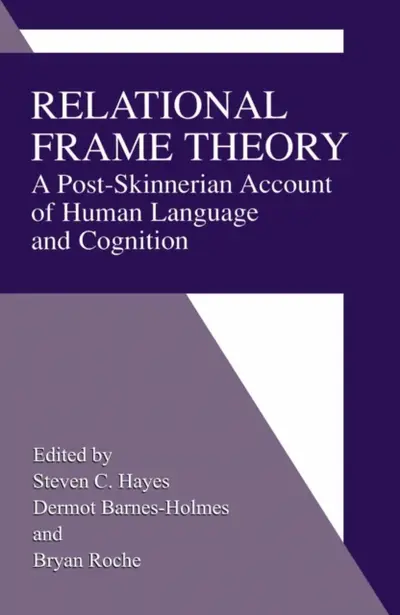
Relational Frame Theory
A Post-Skinnerian Account of Human Language and Cognition
Price and availability
$237.99
Available in: Andorra, Austria, Australia, Belgium, Bulgaria, Canada, Switzerland, Cyprus, Czechia, Germany, Denmark, Estonia, Spain, Finland, France, United Kingdom, Guernsey, Greece, Croatia, Hungary, Ireland, Isle of Man, Iceland, Italy, Jersey, Japan, Liechtenstein, Lithuania, Luxembourg, Latvia, Monaco, Malta, Netherlands, Norway, Poland, Portugal, Romania, Sweden, Slovenia, Slovakia, San Marino, United States, Vatican City, South Africa
Stores: US, UK, Canada, EU, Australia.
Sign in to buyThe price is re-checked by the server before payment.
For personal use under the eBook licence.
- Format
- DRM
- Not stated by the publisher
- Language
- English
- Publisher
- Springer US
- Published
- 30 November 2005
- ISBN
- 9780306476389
- Subjects
- Behavioural theory (Behaviourism), Cognition & cognitive psychology, Clinical psychology, Artificial intelligence, Cognition and cognitive psychology, Clinical psychology, Artificial intelligence (AI)
About this book
Human language and our use of it to communicate or to understand the world requires deriving relations among events: for example, if A=B and A=C, then B=C. Relational frame theory argues that such performances are at the heart of any meaningful psychology of language and cognition. From a very early age, human beings learn relations of similarity, difference, comparison, time, and so on, and modify what they do in a given situation based on its derived relation to others situations and what is known about them. This volume goes beyond theory and gives the empirical and conceptual tools to conduct an experimental analysis of virtually every substantive topic in human language and cognition, both basic and applied. As the term `post-Skinnerian' suggests, this volume challenges behavioral psychology to abandon many of the specific theoretical formulations of its most prominent historical leader in the domain of complex human behavior, especially in human language and cognition, and approach the field from a new direction.The need for a pragmatically useful analysis of language and cognition is as enormous and varied as its extensions and applications. This volume will be of interest not only to behavior theorists but also to cognitive psychologists, therapists, educators, and anyone studying the human condition.
Bibliographic data © Gardners Books Ltd.