PDF · English
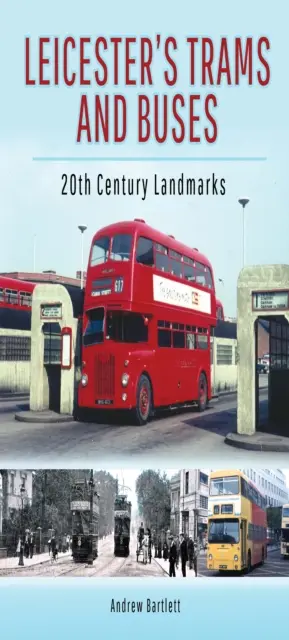
Leicester's Trams and Buses
20th Century Landmarks
Price and availability
$13.99
Available in: Andorra, Austria, Australia, Belgium, Bulgaria, Canada, Switzerland, Cyprus, Czechia, Germany, Denmark, Estonia, Spain, Finland, France, United Kingdom, Guernsey, Greece, Croatia, Hungary, Ireland, Isle of Man, Iceland, Italy, Jersey, Japan, Liechtenstein, Lithuania, Luxembourg, Latvia, Monaco, Malta, Netherlands, Norway, Poland, Portugal, Romania, Sweden, Slovenia, Slovakia, San Marino, United States, Vatican City, South Africa
Stores: US, UK, Canada, EU, Australia.
Sign in to buyThe price is re-checked by the server before payment.
For personal use under the eBook licence.
- Format
- DRM
- Not stated by the publisher
- Language
- English
- Publisher
- Pen and Sword
- Published
- 19 November 2018
- Pages
- 256
- ISBN
- 9781526732521
- Subjects
- United Kingdom, Great Britain, Leicestershire, British & Irish history, Popular culture, Buses, trams & commercial vehicles: general interest, JBCC1, NHD, Buses, trams and commercial vehicles: general interest
About this book
In 1904, when Leicester Corporation opened its state-of-the-art electric tram network, it enjoyed a monopoly on routes and convenient central terminal points. But soon the first small independent motor bus companies became active, and by 1921, Midland Red – shortly to be the largest operator in England outside London – was busily establishing itself. The city fathers were faced with a quandary; protecting their territory and services, and possibly extending them, albeit in the face of determined competition, whilst at the same time endeavouring to provide termini that were as invitingly close to the city centre as possible. In this they were assisted by the 1930 Transport Act, which provided the template for fifty years of fairly peaceful co-existence between Leicester City Transport and Midland Red. That is until the provisions of a new Act in 1980 set them at loggerheads again.Leicester’s Trams and Buses – 20th Century Landmarks examines in detail the background behind five key events – the opening of the electric tram network in 1904 and its closure in 1949; the arrival of Midland Red in Leicester in 1921, via the protracted planning for Leicester’s first proper bus station, to the so-called bus wars in the deregulation and privatisation era of the 1980s. It concludes that it was the pursuit of policies, at local and national government levels, which ultimately led to opportunities being missed that could have provided Leicester city and county with a fully integrated modern-day network.
Bibliographic data © Gardners Books Ltd.