PDF · English
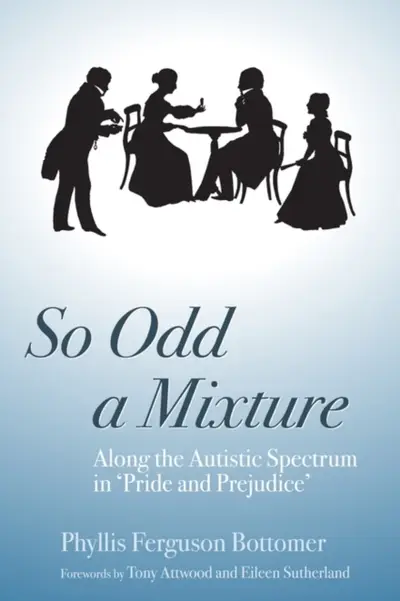
So Odd a Mixture
Along the Autistic Spectrum in ''Pride and Prejudice''
Price and availability
$33.99
Available in: Andorra, Austria, Australia, Belgium, Bulgaria, Canada, Switzerland, Cyprus, Czechia, Germany, Denmark, Estonia, Spain, Finland, France, United Kingdom, Guernsey, Greece, Croatia, Hungary, Ireland, Isle of Man, Iceland, Italy, Jersey, Japan, Liechtenstein, Lithuania, Luxembourg, Latvia, Monaco, Malta, Netherlands, Norway, Poland, Portugal, Romania, Sweden, Slovenia, Slovakia, San Marino, United States, Vatican City, South Africa
Stores: US, UK, Canada, EU, Australia.
Sign in to buyThe price is re-checked by the server before payment.
For personal use under the eBook licence.
- Format
- DRM
- Not stated by the publisher
- Language
- English
- Publisher
- Jessica Kingsley Publishers
- Published
- 15 May 2007
- ISBN
- 9781846426544
- Subjects
- English, Literature: history & criticism, Literary studies: c 1800 to c 1900, Literary studies: fiction, novelists & prose writers, Gender studies: women, Psychology, Child & developmental psychology, Neurology & clinical neurophysiology, Literature: history and criticism, Literary studies: c 1800 to c 1900, Gender studies: women and girls, Psychology, Child, developmental and lifespan psychology
About this book
Autism was not a recognised disorder in Jane Austen's lifetime, nor for well over a century after her death. However there were certainly people who had autism, and Phyllis Ferguson Bottomer proposes that Austen wrote about them, without knowing what it was that she was describing.So Odd a Mixture looks at eight seemingly diverse characters in Austen's classic novel, Pride and Prejudice, who display autistic traits. These characters - five in the Bennet family and three in the extended family of the Fitzwilliams - have fundamental difficulties with communication, empathy and theory of mind. Perhaps it is high-functioning autism or Asperger's Syndrome that provides an explanation for some characters' awkward behaviour at crowded balls, their frequent silences or their tendency to lapse into monologues rather than truly converse with others.This fascinating book will provide food for thought for students and fans of Austen's classic novel, and for anyone interested in autism spectrum disorders.
Bibliographic data © Gardners Books Ltd.