PDF · English
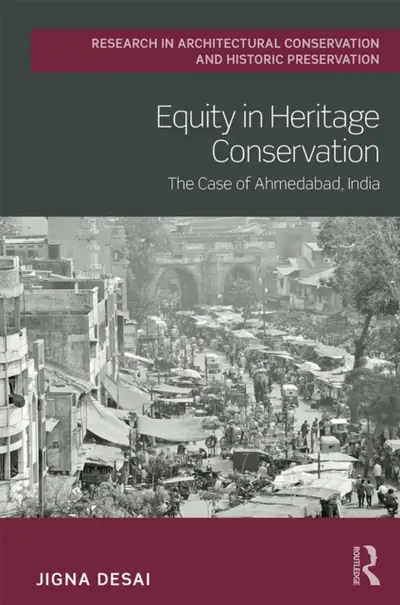
Equity in Heritage Conservation
The Case of Ahmedabad, India
- Society & social sciences
- Nature, environment & geography
- Technology & engineering
- Arts, music & film
- Reference
Price and availability
$66.99
Available in: Andorra, Austria, Australia, Belgium, Bulgaria, Canada, Switzerland, Cyprus, Czechia, Germany, Denmark, Estonia, Spain, Finland, France, United Kingdom, Guernsey, Greece, Croatia, Hungary, Ireland, Isle of Man, Iceland, Italy, Jersey, Japan, Liechtenstein, Lithuania, Luxembourg, Latvia, Monaco, Malta, Netherlands, Norway, Poland, Portugal, Romania, Sweden, Slovenia, Slovakia, San Marino, United States, Vatican City, South Africa
Stores: US, UK, Canada, EU, Australia.
Sign in to buyThe price is re-checked by the server before payment.
For personal use under the eBook licence.
- Format
- DRM
- Not stated by the publisher
- Language
- English
- Publisher
- Taylor & Francis
- Published
- 10 January 2019
- ISBN
- 9780429888656
- Subjects
- India, History of architecture, Museology & heritage studies, Cultural studies, Urban communities, Regional & area planning, Conservation of buildings & building materials, Gujarat, Museology and heritage studies, Sustainability, Urban and municipal planning and policy
About this book
Recognised by the UN's Sustainable Development Goals as a measure to make cities inclusive, safe and resilient, conservation of natural and cultural heritage has become an increasingly important issue across the globe. The equity principle of sustainable development necessitates that citizens hold the right to participate in the cultural economy of a place, requiring that inhabitants and other stakeholders are consulted on processes of continuity or transformation. However, aspirations of cultural exchange do not translate in practice. Equity in Heritage Conservation takes the UNESCO World Heritage City of Ahmedabad, India, as the foundational investigation into the realities of cultural heritage conservation and management. It contextualises the question of heritage by citing places, projects and initiatives from other cities around the world to identify issues, processes and improvements. Through illustrated chapters it discusses the understanding of heritage in relation to the sustainable development of living historic cities, the viability of specific measures, ethics of engagement and recommendations for governance. This book will appeal to a range of scholars interested in cultural heritage conservation and management, sustainable development, urban and regional planning, and architecture.
Bibliographic data © Gardners Books Ltd.