PDF · English
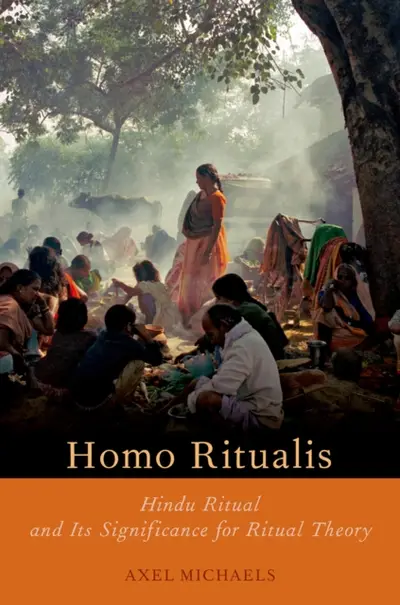
Homo Ritualis
Hindu Ritual and Its Significance for Ritual Theory
Price and availability
$56.99
Available in: Andorra, Austria, Australia, Belgium, Bulgaria, Canada, Switzerland, Cyprus, Czechia, Germany, Denmark, Estonia, Spain, Finland, France, United Kingdom, Guernsey, Greece, Croatia, Hungary, Ireland, Isle of Man, Iceland, Italy, Jersey, Japan, Liechtenstein, Lithuania, Luxembourg, Latvia, Monaco, Malta, Netherlands, Norway, Poland, Portugal, Romania, Sweden, Slovenia, Slovakia, San Marino, United States, Vatican City, South Africa
Stores: US, UK, Canada, EU, Australia.
Sign in to buyThe price is re-checked by the server before payment.
For personal use under the eBook licence.
- Format
- DRM
- Not stated by the publisher
- Language
- English
- Publisher
- Oxford University Press
- Published
- 3 November 2015
- ISBN
- 9780190262648
- Subjects
- Hinduism, Hindu worship, rites & ceremonies, QRD
About this book
Is the richness and diversity of rituals and celebrations in South Asia unique? Are Indians or Hindus more involved in rituals than people of other faiths and other places? If so, what makes them special? Can we speak of a homo ritualis when it comes to India or Hinduism? Drawing on extensive textual studies and fieldwork in Nepal and India, Axel Michaels demonstrates how the characteristic structure of Hindu rituals employs the Brahmanic-Sanskritic sacrifice as a model, and how this structure is one of the distinguishing features of Hinduism more generally. Many religions tend over time to develop less ritualized or more open forms of belief, but Brahmanical Hinduism has internalized ritual behavior to the extent that it has become its most important and distinctive feature, permeating social and personal life alike. The religion can thus be seen as a particular case in the history of religions in which ritual form dominates belief and develops a sweeping autonomy of ritual behavior. Homo Ritualis analyzes ritual through these cultural-specific and religious contexts, taking into account how indigenous terms and theories affect and contribute to current ritual theory. It describes and investigates various forms of Hindu rituals and festivals, such as life-cycle rituals, the Vedic sacrifice, vows processions, and the worship of deities (puja). It also examines various conceptual components of (Hindu) rituals such as framing, formality, modality, and theories of meaning.
Bibliographic data © Gardners Books Ltd.