EPUB · English
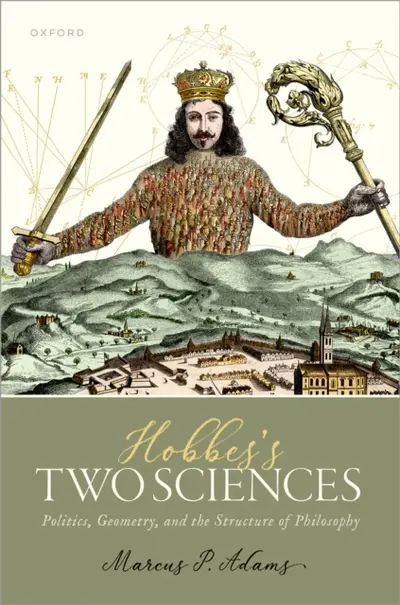
Hobbes's Two Sciences
Politics, Geometry, and the Structure of Philosophy
Price and availability
$72.99
Available in: Andorra, Austria, Australia, Belgium, Bulgaria, Canada, Switzerland, Cyprus, Czechia, Germany, Denmark, Estonia, Spain, Finland, France, United Kingdom, Guernsey, Greece, Croatia, Hungary, Ireland, Isle of Man, Iceland, Italy, Jersey, Japan, Liechtenstein, Lithuania, Luxembourg, Latvia, Monaco, Malta, Netherlands, Norway, Poland, Portugal, Romania, Sweden, Slovenia, Slovakia, San Marino, United States, Vatican City, South Africa
Stores: US, UK, Canada, EU, Australia.
Sign in to buyThe price is re-checked by the server before payment.
For personal use under the eBook licence.
- Format
- EPUB
- DRM
- Not stated by the publisher
- Language
- English
- Publisher
- Oxford University Press
- Published
- 18 January 2025
- ISBN
- 9780198924708
- Subjects
- Philosophy, Western philosophy: c 1600 to c 1900, History of ideas, Political science & theory, History of science, Political science and theory, History of science, Philosophical traditions and schools of thought
About this book
Seventeenth-Century Thinker Thomas Hobbes maintained that his philosophy constituted a unified system, but in what precise sense did he think that the branches of his philosophy were unified? This question has provoked extensive scholarship over the last half-century. Answering it is essential not only to understanding Hobbes's philosophy generally, but how one answers it significantly impacts our understanding of the Leviathan, his most influential work, and of the Laws of Nature, the foundation of his political philosophy. Hobbes's Two Sciences answers the question of philosophical unificiation by situating Hobbes's politics within his account of scientific knowledge as constructed by humans—an epistemology founded on the idea that makers have special access to causal knowledge—and by demonstrating that the relationship between pure and mixed mathematics provided him with a model for thinking about relationships between geometry and natural philosophy and between politics and history. Marcus P. Adams explores how this understanding of Hobbes's systematic philosophy impacts three long-standing areas of scholarship on Hobbes and the History of Early Modern Philosophy and provides a new view on Hobbes's system .
Bibliographic data © Gardners Books Ltd.