EPUB · English
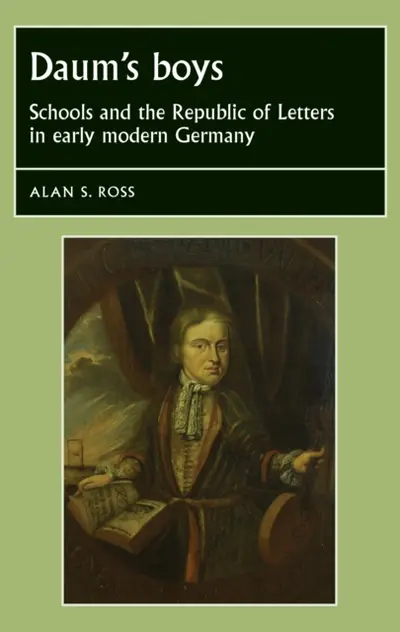
Daum's boys
Schools and the Republic of Letters in early modern Germany
Price and availability
Price unavailable
Available in: Andorra, Austria, Australia, Belgium, Bulgaria, Canada, Switzerland, Cyprus, Czechia, Germany, Denmark, Estonia, Spain, Finland, France, United Kingdom, Guernsey, Greece, Croatia, Hungary, Ireland, Isle of Man, Iceland, Italy, Jersey, Japan, Liechtenstein, Lithuania, Luxembourg, Latvia, Monaco, Malta, Netherlands, Norway, Poland, Portugal, Romania, Sweden, Slovenia, Slovakia, San Marino, United States, Vatican City, South Africa
Stores: US, UK, Canada, EU, Australia.
This title cannot be bought in this store yet: its supplier terms, territorial rights or price are still being confirmed.
For personal use under the eBook licence.
- Format
- EPUB
- DRM
- Not stated by the publisher
- Language
- English
- Publisher
- Manchester University Press
- Published
- 1 April 2015
- ISBN
- 9781784991715
- Subjects
- Germany, c 1600 to c 1700, European history, Early modern history: c 1450/1500 to c 1700, Social & cultural history, Germany, History and Archaeology, European history
About this book
This highly original book is the first in-depth study of a footsoldier of the seventeenth-century German Republic of Letters. Its subject, the polymath and schoolteacher Christian Daum, is today completely forgotten, yet left behind one of the largest private archives of any early modern European scholar. On the basis of this unique source, this book portrays schools as focal points of a whole world of Lutheran learning outside of universities and courts, as places not just of education but of intense scholarship, and examines their significance for German culture.Multi-confessional Germany was different from Catholic France and Protestant England in that its network of small cities fostered educational and cultural competition and made possible a much larger and socially open Republic. This book allows us for the first time to understand how the Republic of Letters was constructed from below and how it was possible for individuals from relatively humble backgrounds and occupations to be at the centre of European intellectual life.This book is aimed at other specialists as well as postgraduate students in the fields of cultural and social history, and can also serve as an introduction to recent European literature on early modern scholarship for undergraduate students.
Bibliographic data © Gardners Books Ltd.