EPUB · English
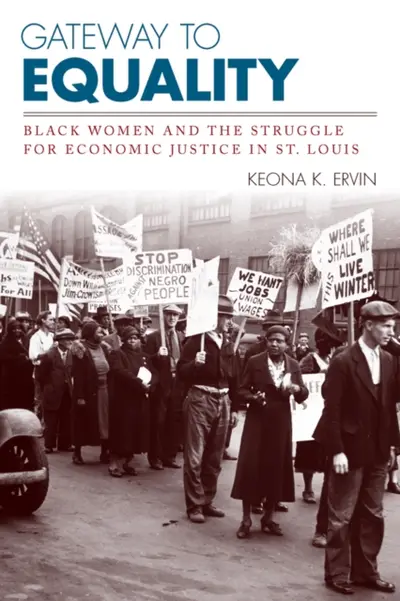
Gateway to Equality
Black Women and the Struggle for Economic Justice in St. Louis
Price and availability
$33.99
Available in: Andorra, Austria, Australia, Belgium, Bulgaria, Canada, Switzerland, Cyprus, Czechia, Germany, Denmark, Estonia, Spain, Finland, France, United Kingdom, Guernsey, Greece, Croatia, Hungary, Ireland, Isle of Man, Iceland, Italy, Jersey, Japan, Liechtenstein, Lithuania, Luxembourg, Latvia, Monaco, Malta, Netherlands, Norway, Poland, Portugal, Romania, Sweden, Slovenia, Slovakia, San Marino, United States, Vatican City, South Africa
Stores: US, UK, Canada, EU, Australia.
Sign in to buyThe price is re-checked by the server before payment.
For personal use under the eBook licence.
- Format
- EPUB
- DRM
- Not stated by the publisher
- Language
- English
- Publisher
- The University Press of Kentucky
- Published
- 28 July 2017
- ISBN
- 9780813169866
- Subjects
- USA, Missouri, 20th century, History of the Americas, 20th century history: c 1900 to c 2000, Social & cultural history, Gender studies: women, Ethnic studies, Ethnic minorities & multicultural studies, Black & Asian studies, Human rights, Civil rights & citizenship, Economic history, Ethnic studies / Ethnicity, Human rights, civil rights, Social and cultural history
About this book
Like most of the nation during the 1930s, St. Louis, Missouri, was caught in the stifling grip of the Great Depression. For the next thirty years, the "Gateway City" continued to experience significant urban decline as its population swelled and the area's industries stagnated. Over these decades, many African American citizens in the region found themselves struggling financially and fighting for access to profitable jobs and suitable working conditions. To combat ingrained racism, crippling levels of poverty, and sub-standard living conditions, black women worked together to form a community-based culture of resistancefighting for employment, a living wage, dignity, representation, and political leadership.Gateway to Equality investigates black working-class women's struggle for economic justice from the rise of New Deal liberalism in the 1930s to the social upheavals of the 1960s. Author Keona K. Ervin explains that the conditions in twentieth-century St. Louis were uniquely conducive to the rise of this movement since the city's economy was based on light industries that employed women, such as textiles and food processing. As part of the Great Migration, black women migrated to the city at a higher rate than their male counterparts, and labor and black freedom movements relied less on a charismatic, male leadership model. This made it possible for women to emerge as visible and influential leaders in both formal and informal capacities.In this impressive study, Ervin presents a stunning account of the ways in which black working-class women creatively fused racial and economic justice. By illustrating that their politics played an important role in defining urban political agendas, her work sheds light on an unexplored aspect of community activism and illuminates the complexities of the overlapping civil rights and labor movements during the first half of the twentieth century.
Bibliographic data © Gardners Books Ltd.