PDF · English
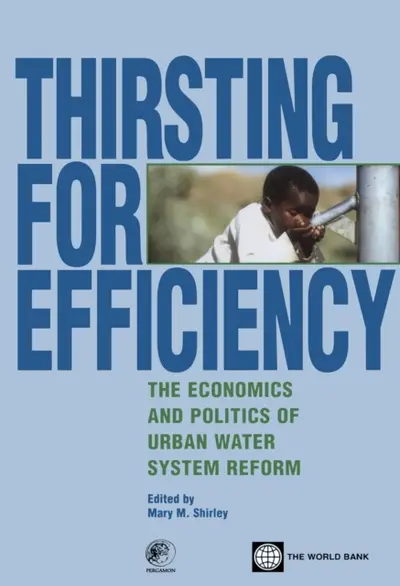
Thirsting for Efficiency
The Economics and Politics of Urban Water System Reform
Price and availability
$112.99
Available in: Andorra, Austria, Australia, Belgium, Bulgaria, Canada, Switzerland, Cyprus, Czechia, Germany, Denmark, Estonia, Spain, Finland, France, United Kingdom, Guernsey, Greece, Croatia, Hungary, Ireland, Isle of Man, Iceland, Italy, Jersey, Japan, Liechtenstein, Lithuania, Luxembourg, Latvia, Monaco, Malta, Netherlands, Norway, Poland, Portugal, Romania, Sweden, Slovenia, Slovakia, San Marino, United States, Vatican City, South Africa
Stores: US, UK, Canada, EU, Australia.
Sign in to buyThe price is re-checked by the server before payment.
For personal use under the eBook licence.
- Format
- DRM
- Not stated by the publisher
- Language
- English
- Publisher
- Elsevier Science
- Published
- 18 April 2002
- ISBN
- 9780080913452
- Subjects
- Development studies, Environmental economics, Water industries, Environmental management, Waste management, Environmental science, engineering & technology, Environmental science, engineering and technology
About this book
One billion people in the world lack safe drinking water and almost 2 billion lack adequate sanitation services. As a result millions suffer and die every year from water and sanitation related diseases. Poor management and inefficient investment are often responsible for this situation, and countless past attempts at reform have accomplished little. Recently some developing countries have tried to reverse years of mismanagement of their water and sewerage systems by auctioning contracts to private operators. Why do countries that have tolerated mismanagement for decades develop a thirst for efficiency? What are the results of their efforts to change? What determines success or failure? This book fills a gap in the literature by systematically answering these important questions. It does so by analyzing reforms in six developing country capitals -- Buenos Aires, Argentina; Lima, Peru; Mexico City, Mexico; Santiago, Chile; Abidjan, Cote d'Ivoire; and Conakry, Guinea - and the United States in the 19th century.It not only assesses economic factors, but also explores the roles of laws, politics and norms. It provides an economic theory of water that encompasses institutional, political and economic aspects of reform.
Bibliographic data © Gardners Books Ltd.